

 ENG
ENG 中文简体
中文简体 русский
 Français
 Español
 日本語
日本語 عربى
عربىContent
If you have watched boxed goods glide steadily under a labeling head, or seen freshly stamped parts carried away from a press without an operator touching them, you have seen a flat belt conveyor doing its job. The short answer to when you should specify one: whenever products need a smooth, continuously supported surface, a consistent speed, and quiet operation, a flat belt conveyor is usually the most economical and reliable option on the floor.
That conclusion comes with boundaries. Flat belts favor items with reasonably flat bottoms and loads from a few hundred grams up to the medium-weight range, and they are the wrong tool when a process depends on accumulation zones or on air and fluid passing through the carrying surface. The sections below cover how these conveyors work, how belt materials and layouts differ, where they beat roller-based systems, and which purchase and maintenance details decide whether a belt runs straight for years or wanders into the frame every shift.
What a Flat Belt Conveyor Is and How It Moves Product
A flat belt conveyor is a continuous transport system built around an endless belt with a flat carrying surface, stretched between a driven pulley at the discharge end and an idler pulley at the infeed. When the drive pulley turns, friction between the pulley and the inner face of the belt pulls the belt forward, and friction between the top surface and the product carries the load along at belt speed. Nothing on the belt slides relative to the belt itself, which is exactly why these conveyors hold items in a fixed orientation so well.
Because transport depends on friction, three factors dominate performance: belt tension, pulley grip, and the condition of the carrying surface. A tensioning device keeps the belt snug against the drive pulley, a crowned drive pulley keeps the belt centered, and the belt cover material, whether smooth PVC or grippy rubber, determines how reliably a given product stays put, especially on an incline.
The hardware is simple enough to evaluate part by part:
- Carrying belt: the working surface, typically PVC, PU, or rubber over a fabric carcass.
- Drive pulley: transmits motor torque to the belt through a geared motor or a motorized drum.
- Tail pulley and return rollers: guide the belt back and define the carrying path.
- Support structure: a slider bed gives small parts full support, while a roller bed lowers friction on longer, heavier runs.
- Take-up device: screws or springs that maintain tension as the belt stretches in service.
Belt Materials and Layout Options
Matching the Belt to the Job
PVC is the default for boxes, totes, and general manufacturing because it is economical, resists water and mild chemicals, and lasts for years in normal duty. Polyurethane is the material to ask for in food contact and oily environments, since it handles washdown and resists fats and oils far better. Rubber covers give the best grip and abrasion resistance for heavier loads and steeper inclines. Surface features matter as much as the base material: rough-top patterns add friction for inclines, cleats hold loose or mixed items in place, and low guide strips keep small parts from drifting sideways.
Straight, Inclined, and Curved Configurations
The straight flat belt is the workhorse: two pulleys, a support bed, and a drive, ideal for point-to-point transfer between machines, under press lines, and along assembly benches. Incline and decline versions use higher-friction covers and sometimes cleats to move product between floor level and machine beds. Curved versions carry product around corners while keeping its orientation, which requires a wider belt with a tapered inner edge and careful speed management so the outside of the curve does not outrun the inside.
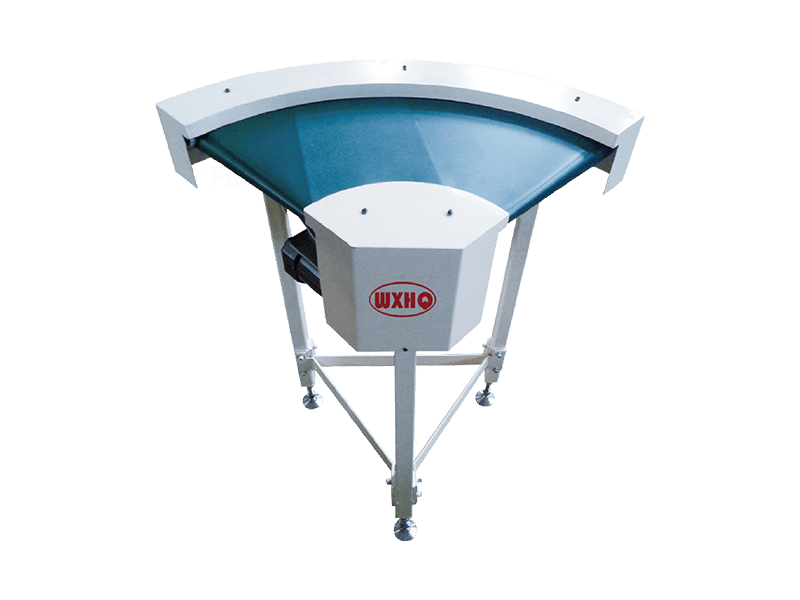 Turning Belt Conveyor for 90° and 180° TransfersA belt turning machine built to redirect product between conveyor lines while keeping boxes square to the flow. Belts in PVC, PU, and PVK suit ordinary loads and materials needing oil, chemical, or static resistance.View Product →
For a line that must change direction, a purpose-built turning unit is far more predictable than improvising with angled plates, because the tapered geometry keeps boxes square to the flow as they exit the curve.
Where Flat Belt Conveyors Earn Their Keep
Assembly and stamping operations are the clearest fit. On assembly lines, the flat surface gives operators a stable work platform and holds parts in position for robot pickup or manual fitting. In press shops, a dedicated stamping line belt conveyor moves hot or oiled stampings away from the press at a controlled pace, with belt covers selected to tolerate oil and sharp edges better than roller surfaces would.
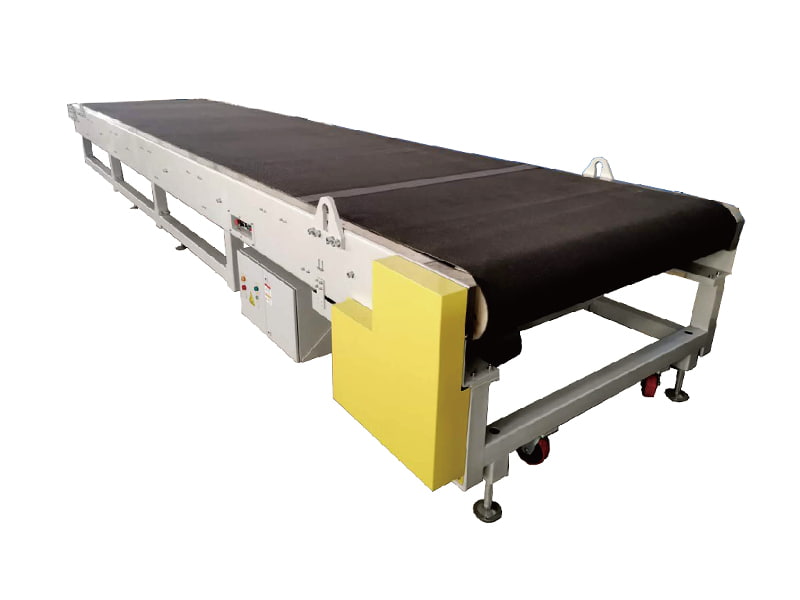 Stamping Line Belt Conveyor for Sheet Metal PartsA heavy-duty belt conveyor for moving hot or oiled stampings away from presses at a controlled pace. Cut-resistant PU or PVK belts and rigid frames handle continuous automotive stamping, inspection, and in-line processing.View Product →
Food processing is another strong match: washdown-capable PU belts carry washed, sorted, and packed produce through grading and packing stations, and the continuous surface keeps crumbs and small debris on the belt where they can be scraped off instead of falling between rollers. Parcel and airport operations use flat belts at induct points and security lanes, where soft, irregular bags need full support before reaching scanners.
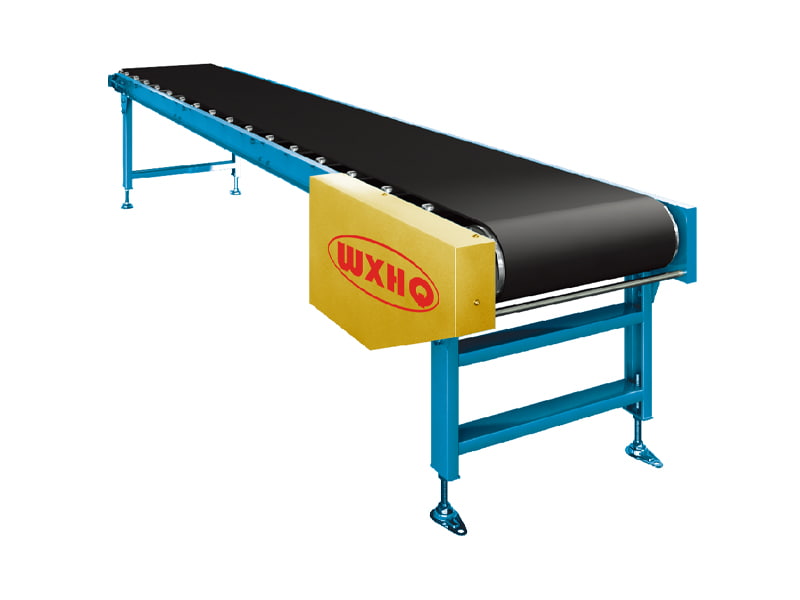 Standard Type Belt Conveyor for General HandlingA lightweight belt conveyor for items under 100 kg or powder and granular material, running fast, smooth, and quiet. Multiple belt options, including PVC, PU, silicone, and PTFE, cover most general manufacturing and packaging duties.View Product →
For most general manufacturing and packaging duties, a standard-type belt conveyor covers the majority of these roles out of the box, which is why it remains one of the most widely specified units in any conveyor catalogue.
Flat Belt Conveyor or Roller Conveyor?
The most common comparison in a conveyor purchase is flat belt versus roller. The honest summary: rollers win on accumulation, gravity flow, and handling items with worn or uneven bottoms; flat belts win on smooth support, steady speed, inclines, and small or soft items that would fall between rollers.
| Characteristic | Flat Belt Conveyor | Roller Conveyor |
|---|---|---|
| Product support | Full, continuous support under the whole item | Support only at roller contact points |
| Best suited loads | Small, soft, bagged, or flat-bottomed items | Rigid items with firm, even bottoms |
| Speed control | Precise and uniform across the belt | Depends on drive type and product friction |
| Accumulation | Limited; products ride continuously | Excellent with accumulating rollers and zones |
| Incline capability | Strong with high-friction covers or cleats | Poor; gravity rollers convey downhill only |
| Typical weak points | Tracking, tension, and cover wear | Bearing wear and hang-up between rollers |
What to Check Before You Buy
Most flat belt conveyor disappointments trace back to four specification errors, not to the concept itself. Sort these out before comparing quotations:
- Load reality: confirm the heaviest item, not the average one, plus the worst bottom surface. A creased carton that sags between supports tells you whether you need a slider bed or a roller bed.
- Duty cycle and speed: state the required belt speed and whether it must vary. A variable frequency drive is inexpensive insurance for lines whose upstream pace changes.
- Environment: oil, metal chips, dust, temperature, and washdown requirements determine both the belt cover and the drive unit. Enclosed drum motors, for example, protect the drive from washdown and debris better than exposed gearmotors.
- Integration: decide early where sensors, stops, and scanners sit, and confirm the supplier can provide mounting points and control signals, because retrofitting controls onto an unsuitable frame is slow and costly.
Also weigh supplier factors that never appear on the drawing: availability of replacement belts in your width and profile, whether pulleys are crowned for tracking, and how quickly the manufacturer answers technical questions. A supplier that manufactures the conveying line and its drive components, as Wuxi Huiqian does across its belt, roller, and motorized drum product ranges, can match the drive to the belt instead of forcing you to reconcile two vendors' assumptions.
Maintenance: Tracking, Tension, and Cleanliness
Flat belt maintenance is not demanding, but it rewards consistency. Nearly all field problems fall into three groups: the belt wanders to one side, the belt slips under load, or the cover wears prematurely. All three usually trace back to tension and tracking.
- Tracking: if the belt drifts, adjust the snub or take-up rollers in small steps while the belt is running; large corrections usually signal a misaligned pulley or an out-of-square frame.
- Tension: too loose and the belt slips on the drive pulley, glazing the cover; too tight and you overload bearings and stretch the carcass. Set tension to the minimum that prevents slippage at peak load.
- Cleanliness and inspection: scrape off accumulated debris weekly, check the splice and belt edges monthly, and listen for bearing noise at the pulleys during every walk-down.
For a schedule that covers belt life, splicing, and periodic inspection intervals in more depth, see this guide to long-term belt conveyor maintenance before you finalize your service plan.
Flat belt conveyors remain the default answer for one simple reason: a continuous, supported surface is the gentlest and most controllable way to move product from one fixed point to another. Choose the belt cover for your environment, keep tension and tracking honest, and match the drive and controls to the process rather than the other way around, and a flat belt line will quietly do its job for years. When loads are rigid-bottomed and need to wait in queues instead, that is the moment to look at rollers, but for everything that must ride steady, the flat belt still sets the standard.