

 ENG
ENG 中文简体
中文简体 русский
 Français
 Español
 日本語
日本語 عربى
عربىContent
A conveyor that delivers a new unit every 40 seconds cannot support a station where the work takes 70 seconds. The queue grows, the operator starts rushing, and the defect rate follows within a shift. That mismatch, not the brand of conveyor, is what most often dooms an assembly line that looked fine on paper. The useful way to think about a conveyor assembly line is as the production line's metronome: it sets the pace every station works to, absorbs the time differences between stations, and presents each product at a height and orientation people can actually build at. Specify those three jobs correctly and most conveyor types will run well. Get them wrong and no amount of extra line length will save the schedule.
What a Conveyor Assembly Line Actually Controls
The first number to fix is takt time: how often a finished unit must leave the line to meet demand. If a shift must produce 480 units in eight hours, the line owes one unit every minute. With a pallet pitch of 1.5 metres, the conveyor's average transport speed works out to 1.5 m/min, a figure that powered systems can hold within close tolerance using a variable-frequency drive. Every station upstream and downstream then staffs, tools and times itself against that rhythm.
The second job is buffering. No two stations take exactly the same time, so a well-planned line builds short accumulation zones between them, letting a slow station work while the conveyor holds finished pieces behind it instead of pushing them into the operator's elbows.
The third is ergonomics. Working height, fixture angle, and whether a part can be stopped, rotated or flipped at the station determine fatigue over an eight-hour shift. These three functions — pacing, buffering, presenting — are why the moving assembly line has barely changed in principle since the Model T chassis passed through 45 stations in roughly 93 minutes; only the accuracy of the pacing has improved. For a fuller treatment of the payoff, see this overview of the benefits of an assembly line conveyor system.
Matching the Conveyor Type to the Work
Most assembly conveyors are built from standard modules with custom features added, so the real decision is which family of conveyor fits the product. Belt conveyors are the default for small parts and delicate surfaces: the load rests on a continuous surface, the frame can be low-profile, speeds are easy to trim, and noise stays low. Their weakness is accumulation — a standard belt keeps moving, so parts pile up unless you add stops or sensors.
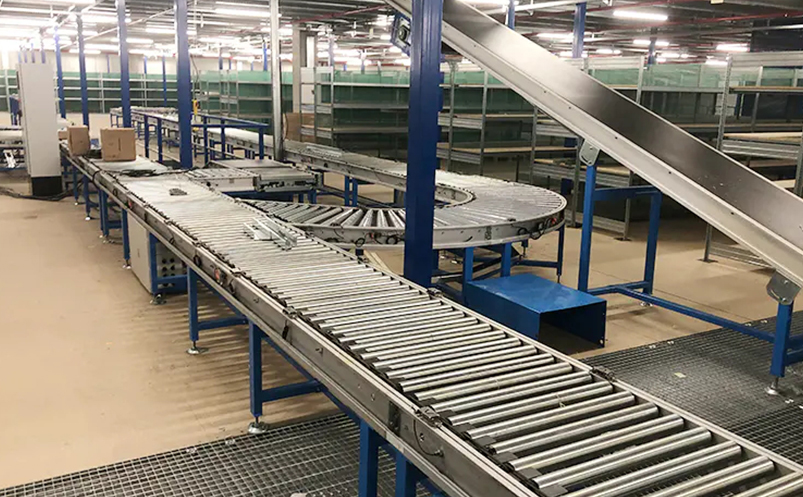
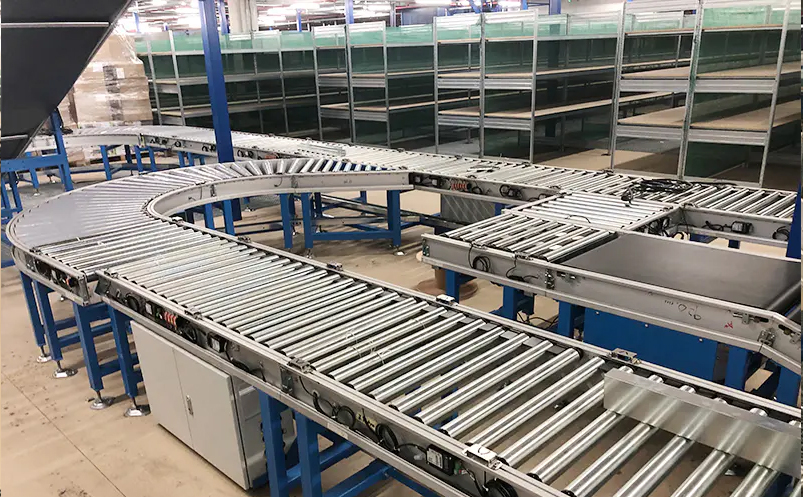
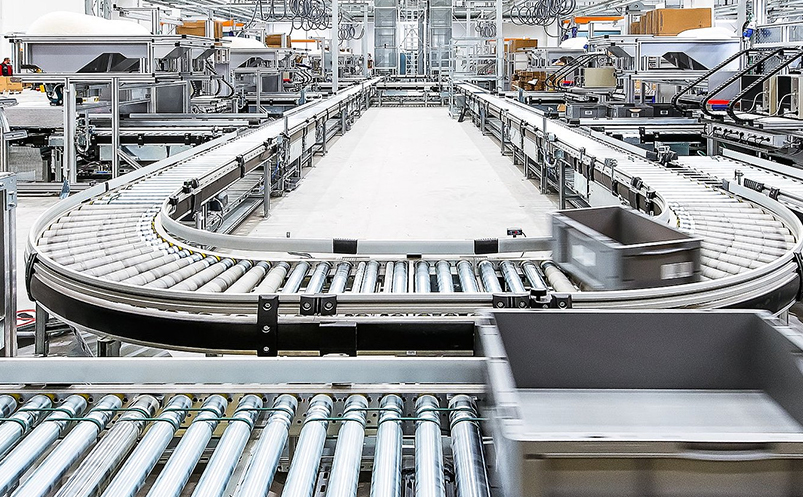
Roller conveyors suit anything with a firm, flat bottom: totes, trays, pallets and machined housings. Gravity versions keep manual pick stations cheap and quiet; powered accumulating versions divide the line into zones that run, stop or hold independently, which is how most pallet-based assembly lines breathe. The trade-off is contact: roller pitch must match the load, generally with at least three to four rollers under the shortest item at all times.
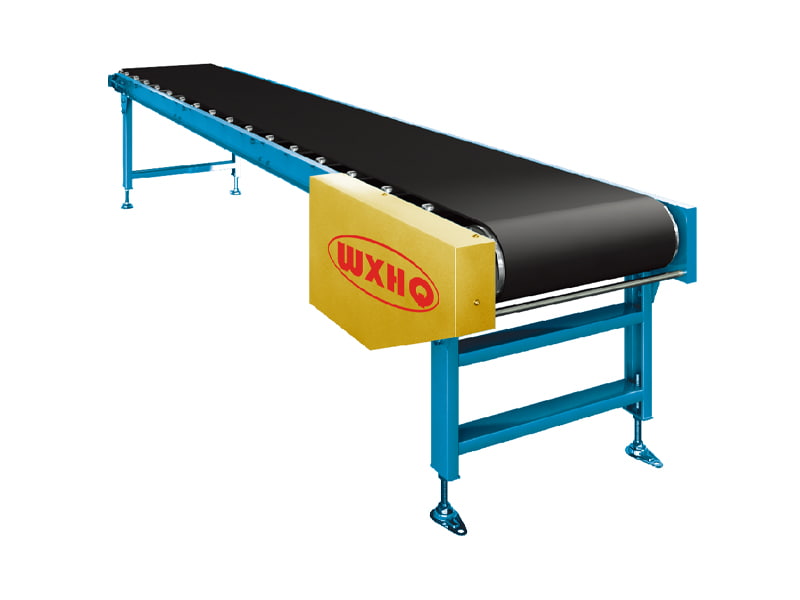 Standard Belt Conveyors for Light LoadsThe standard belt conveyor moves items under 100KG or powder and granular material smoothly and quietly, with belt options like PVC, PU and PTFE. After roller conveyors handle flat-bottomed loads, belts cover the lighter, irregular items rollers cannot.View Product →
| Conveyor type | Best suited to | How it paces work | Main limitation |
|---|---|---|---|
| Belt | Small parts, soft or delicate bottoms | Continuous or indexed belt speed | No built-in accumulation |
| Accumulating roller | Pallets and totes with firm flat bottoms | Zones run, stop or hold independently | Contact and roller pitch matter |
| Gravity roller or wheel | Manual pick stations, short moves | Operator-paced, no drive | Speed set only by slope and spacing |
| Slat-top chain | Heavy or irregular products on fixtures | Fixture travels with the chain | Fixtures add tooling cost |
| Double-speed chain | Free pallets with stop-and-go stations | Pallets move faster than the chain and stop without halting the line | Pallet and stopper hardware required |
Chain Conveyors: Fixtures, Pallets and Stop-and-Go Logic
Two chain families dominate the assembly work where belts and rollers run out of answers.
Slat-top chain for fixture-built products
Engines, gearboxes, pumps and loaded housings are heavy, oily and rarely flat-bottomed. A slat-top chain gives them a continuous steel or plastic platform, and fixtures bolt directly to the chain, so the product travels, stops and transfers without ever being lifted. The result is a stable work surface at a fixed height, which is why slat conveyors are common in appliance, motorcycle and small-engine final assembly.
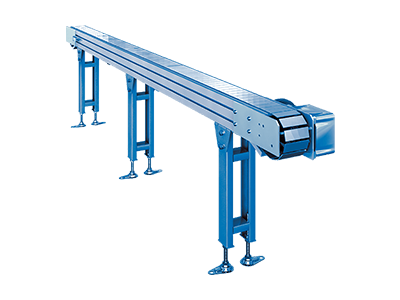 Slat Top Chain Conveyors for Heavy AssemblySlat chain conveyors provide a continuous steel or plastic platform where fixtures bolt directly onto the chain, keeping heavy, oily, uneven products stable at a fixed working height. This makes them well suited to appliance and engine final assembly.View Product →
Double-speed chain for free pallets
A double-speed chain conveyor carries workpiece pallets on rollers that turn several times faster than the chain beneath them, so a light push from the operator glides the pallet to a comfortable working position. At a stopper, the pallet halts while the chain keeps running underneath it, which means each station can stop, hold and release independently without stopping the line. That stop-and-go independence is exactly what electronics and appliance final assembly need, and it pairs naturally with lifts, turntables and merges between parallel lines.
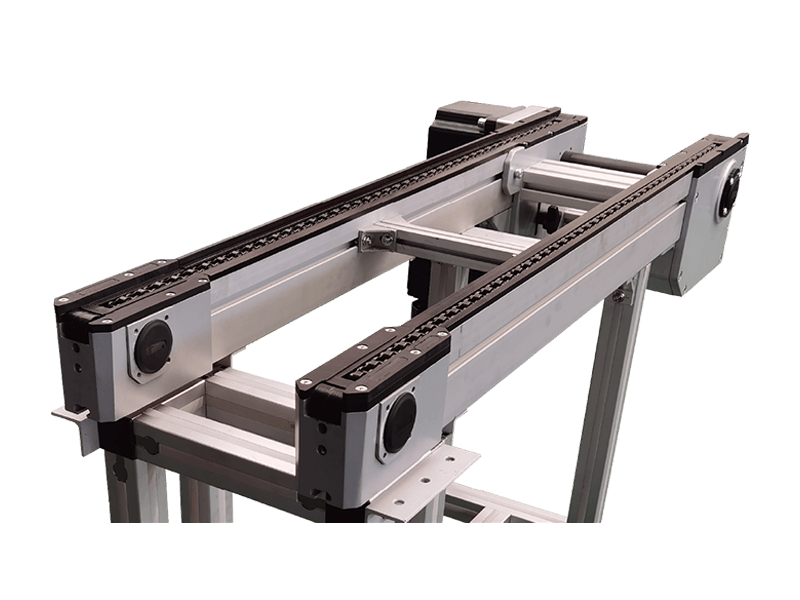 Double Speed Chain ConveyorsDouble speed chain conveyors carry workpiece pallets on rollers running several times faster than the chain, letting operators glide pallets easily. Each station can stop, hold and release independently, which suits electronics and appliance assembly lines.View Product →
Specification Details That Decide Day-Two Performance
Once the type is chosen, five details separate a line that runs from one that needs constant attention:
- Takt time and pallet pitch, so transport speed and buffer lengths are calculated rather than guessed.
- Product data, including weight, dimensions, bottom geometry and temperature, because a soft bag, a round casting and a rigid tote need different contact surfaces.
- The station list, noting which operations require the product to be stopped, rotated, lifted or flipped.
- Accumulation points and buffer depth between stations, sized from measured station-time variation rather than averages.
- Environment and certifications: washdown areas call for stainless steel rollers, electronics lines need ESD-safe surfaces, and paint or solvent areas require explosion-proof certified equipment.
Two of these deserve extra attention. Speed regulation is not just a top number; the drive must hold speed steadily as loads change, because a roller conveyor that wanders or vibrates during speed adjustment will also wander at the stations. And in any area where flammable vapours are present — paint shops above all — specify certified explosion-proof conveyors. Equipment such as EETI-certified roller conveyors exists precisely for these zones, and accepting uncertified units there is a compliance risk rather than a saving.
Where Buyers Get Caught Out
The recurring mistakes are unglamorous. Buyers specify length and width and forget bottom geometry, then discover that vacuum-formed trays will not ride rollers. They plan straight runs in detail and treat turns, lifts and merges as afterthoughts, although transfers cause more jams per metre than any straight section. They skip the pallet interface question — who designs the pallet and what tolerance the locating surfaces hold — and pay for it when fixtures from one supplier and station tooling from another do not agree. They also forget spares: rollers, chains and drive units wear, so a supplier who can ship replacement parts to your region is worth more than a marginally lower quote.
Specified in that order — pace first, product second, buffering and environment third — a conveyor assembly line becomes predictable production equipment rather than a gamble. If you are scoping a line, send the station list, product drawings and target takt time to the manufacturer and ask for the conveyor selection and layout in writing. You can review the factory, certifications and full product range on the About Wuxi Huiqian Logistics Machinery page before requesting a quote.