

 ENG
ENG 中文简体
中文简体 русский
 Français
 Español
 日本語
日本語 عربى
عربىContent
A conveyor system is a mechanical handling apparatus that transports materials, products, or packages from one location to another within a facility or between multiple points in an industrial process. These systems use motorized belts, rollers, chains, or other mechanisms to move items continuously or intermittently, eliminating manual carrying and significantly improving operational efficiency. Conveyor systems are fundamental to modern manufacturing, warehousing, distribution centers, airports, mining operations, and countless other industries where material movement is essential.
From simple gravity-fed roller conveyors in small workshops to sophisticated automated belt systems in Amazon fulfillment centers processing over 5 million packages daily, these systems have become indispensable infrastructure in the global supply chain. Understanding how conveyor systems work, their types, and applications helps businesses optimize their operations and reduce labor costs by up to 50% in material handling tasks.
Core Components of Conveyor Systems
Every conveyor system, regardless of complexity, consists of several essential components that work together to facilitate material movement:
Belt or Carrying Medium
The belt, chain, rollers, or slats form the surface that directly contacts and transports materials. Belt conveyors typically use rubber, PVC, or fabric-reinforced materials with varying thicknesses from 3mm to 25mm depending on load requirements. For heavy-duty applications like mining, steel-cord reinforced belts can handle loads exceeding 10,000 tons per hour.
Drive Unit and Motor
The drive system powers the conveyor, typically consisting of electric motors ranging from 0.5 HP for light-duty applications to over 500 HP for large-scale mining conveyors. Variable frequency drives (VFDs) allow operators to adjust speed from 10 feet per minute to over 1,000 feet per minute, optimizing throughput for different materials.
Support Structure and Frame
The frame provides structural support, manufactured from steel, aluminum, or stainless steel depending on environmental conditions. Industrial frames must withstand dynamic loads, with heavy-duty systems engineered to support 150-300 pounds per linear foot.
Pulleys and Idlers
Pulleys redirect and tension the belt, while idlers support the belt between the drive and tail pulleys. A typical 100-foot belt conveyor might use 20-30 idler sets spaced at 3-5 foot intervals to prevent sagging and ensure smooth operation.
Types of Conveyor Systems and Their Applications
Different industries require specialized conveyor configurations to handle unique material characteristics and operational demands:
| Conveyor Type | Best Applications | Typical Speed Range | Load Capacity |
|---|---|---|---|
| Belt Conveyor | Bulk materials, packages, manufacturing | 50-500 ft/min | Up to 5,000 lbs/ft |
| Roller Conveyor | Boxes, pallets, unit loads | 30-200 ft/min | 50-3,000 lbs/ft |
| Chain Conveyor | Heavy pallets, automotive parts | 10-100 ft/min | Up to 10,000 lbs/ft |
| Overhead Conveyor | Painting, assembly lines, garments | 5-50 ft/min | 50-500 lbs/carrier |
| Screw Conveyor | Powders, granules, grains | 20-150 ft/min | Up to 2,000 cu ft/hr |
Belt Conveyors
Belt conveyors dominate general-purpose material handling, accounting for approximately 60% of all conveyor installations globally. In the mining industry, single belt conveyors can extend over 10 miles, such as the system at Western Sahara's phosphate mines, transporting 2,000 tons of material per hour across challenging desert terrain.
Roller Conveyors
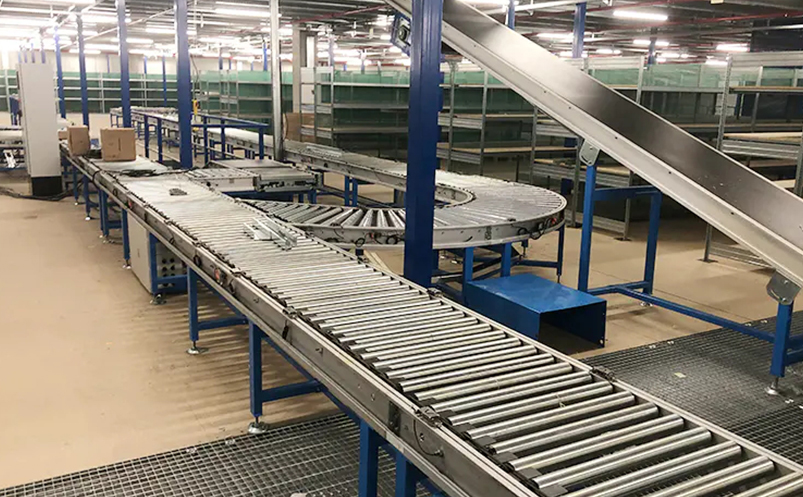
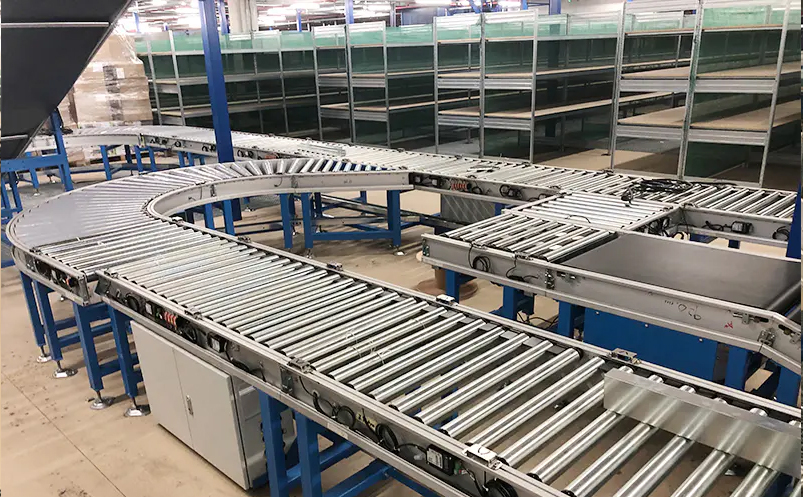
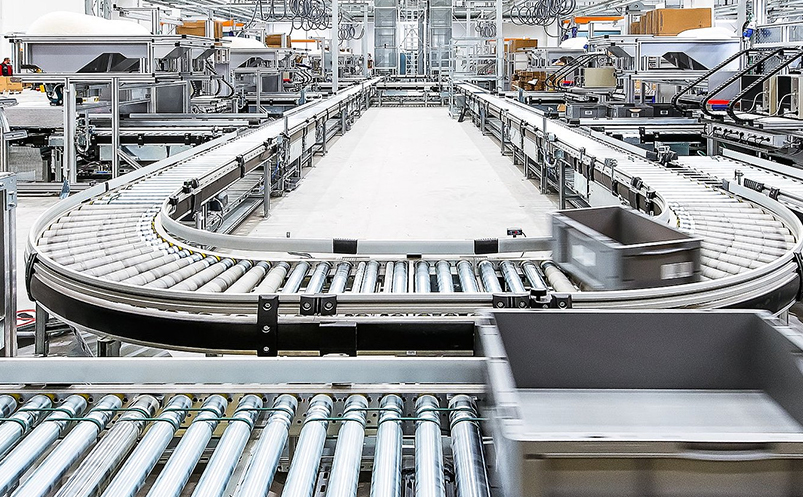
Roller conveyors excel in distribution centers where packages with firm, flat bottoms need to move efficiently. FedEx and UPS facilities use thousands of feet of roller conveyors with accumulation zones that can hold hundreds of packages while maintaining zero pressure between items, preventing damage during sorting operations.
Specialized Conveyors
Magnetic conveyors transport ferrous metal parts in machining operations, pneumatic conveyors move lightweight materials through enclosed tubes at speeds up to 5,000 feet per minute, and bucket elevators lift bulk materials vertically up to 200 feet in grain silos and cement plants.
Key Benefits and Efficiency Improvements
Organizations implementing conveyor systems report measurable improvements across multiple operational metrics:
- Labor cost reduction: Automated conveyors eliminate the need for manual material carriers, reducing labor requirements by 40-60% in typical warehousing operations. A single conveyor system can replace the work of 10-15 workers in continuous operation scenarios.
- Throughput increase: Modern sortation conveyors in e-commerce facilities can process 12,000-15,000 items per hour, compared to 300-500 items per hour for manual sorting operations, representing a productivity increase of over 2,400%.
- Safety improvements: The U.S. Bureau of Labor Statistics reports that facilities using conveyor systems experience 70% fewer back injuries and material handling-related accidents compared to manual operations.
- Space optimization: Overhead and vertical conveyors reclaim floor space, with some installations freeing up 30-40% of floor area previously used for material staging and transportation lanes.
- Quality consistency: Automated conveyors reduce product handling damage by maintaining controlled speeds and eliminating dropping or rough handling, decreasing damage claims by up to 80% in fragile goods operations.
For example, Tesla's Fremont factory employs over 5 miles of conveyors integrated with robotic assembly stations, enabling the facility to produce up to 500,000 vehicles annually with minimal manual material movement.
Design Considerations and Selection Criteria
Selecting the appropriate conveyor system requires careful analysis of operational requirements and material characteristics:
Material Characteristics
Material properties dictate conveyor design decisions. Abrasive materials like sand or crushed rock require thick rubber belts (10-25mm) with high wear resistance, while delicate electronics need smooth, anti-static belts with gentle acceleration profiles limited to 0.5 ft/sec² to prevent component damage.
Load Requirements
Engineers calculate load capacity by considering both the weight per item and the density of items on the belt. A conveyor handling 50-pound boxes spaced 2 feet apart requires different specifications than one handling 5-pound packages at 200 items per minute, even if total hourly throughput is similar.
Environmental Factors
Food processing facilities require stainless steel construction and FDA-approved belt materials to withstand daily washdowns with caustic cleaning agents. Cold storage applications demand belts rated for temperatures as low as -40°F, while foundries need heat-resistant belts capable of withstanding 400°F+ environments.
Integration Requirements
Modern conveyors integrate with warehouse management systems (WMS), programmable logic controllers (PLCs), and sensors that track every item. Barcode scanners reading at 99.9% accuracy rates enable real-time inventory tracking, while weight scales built into conveyors can verify package contents at speeds exceeding 200 packages per minute.
Maintenance and Operating Costs
Understanding total cost of ownership helps organizations budget appropriately for conveyor systems throughout their operational lifecycle:
Preventive Maintenance Schedule
Properly maintained conveyors operate for 15-25 years before requiring major overhauls. Daily inspections focus on belt tracking and unusual noises, weekly checks include lubrication of bearings (requiring 2-4 ounces of grease per bearing), and monthly inspections verify belt tension and pulley alignment.
Common Replacement Parts
Belts typically require replacement every 3-7 years depending on usage intensity, costing $15-$150 per linear foot depending on material and width. Bearings last 2-5 years with proper lubrication, motors operate 10-15 years, and drive chains need replacement every 5-8 years in chain-driven systems.
Energy Consumption
A 100-foot belt conveyor running continuously consumes approximately 1.5-3 kW, translating to $1,000-$2,000 annually in electricity costs at industrial rates. Energy-efficient motors and VFDs can reduce consumption by 20-30%, paying for themselves within 2-3 years.
Annual maintenance costs typically range from 2-5% of initial system cost, meaning a $100,000 conveyor installation should budget $2,000-$5,000 yearly for routine maintenance and unexpected repairs.
Advanced Technologies and Future Trends
Conveyor technology continues evolving with innovations that enhance automation, intelligence, and sustainability:
Smart Sensors and Predictive Maintenance
Internet of Things (IoT) sensors monitor vibration, temperature, and belt speed in real-time, detecting anomalies before failures occur. Companies using predictive maintenance report 35-45% reduction in unplanned downtime and 25% lower maintenance costs through early intervention.
Modular and Flexible Designs
Modern modular conveyors allow rapid reconfiguration to adapt to changing production requirements. Plug-and-play sections can be repositioned in hours rather than days, supporting agile manufacturing and seasonal demand fluctuations without significant downtime.
Energy Recovery Systems
Regenerative braking systems capture energy from downhill conveyor sections and deceleration zones, feeding power back into the electrical grid. Large mining operations report recovering 15-20% of conveyor energy consumption through regenerative systems, significantly reducing operational costs.
AI-Powered Optimization
Artificial intelligence algorithms optimize conveyor speeds based on real-time demand, reducing energy consumption during low-volume periods while maintaining throughput targets. Early adopters report 10-15% energy savings without sacrificing performance metrics.
The global conveyor system market, valued at $7.2 billion in 2023, is projected to reach $10.5 billion by 2030, driven by e-commerce growth, warehouse automation, and manufacturing expansion in emerging economies.