

 ENG
ENG 中文简体
中文简体 русский
 Français
 Español
 日本語
日本語 عربى
عربىContent
A packing supervisor watches three workers spend the first hour of every shift carrying eight-kilogram cartons forty meters from bench to dock — hundreds of manual lifts per person, per day, for work a strip of rollers could do unaided. That daily arithmetic is the plainest case for roller conveyors.
The short answer up front: if your loads have firm, flat bottoms — cartons, totes, cases, drums, pallets — a roller conveyor is almost always the right starting point, and the decision that matters most is not price per meter but the combination of drive type, roller pitch, and roller material. Get those three right and the system runs for years on modest care; get them wrong and you inherit jams, scuffed goods, and bearings that fail a season early.
What a Roller Conveyor Actually Does
A roller conveyor is a frame holding rollers at a fixed spacing called the roller pitch. Loads ride on top, and motion comes either from gravity on a slight decline or from power transferred to the rollers by belts, chains, or built-in motors. Because loads roll rather than drag, friction stays low, and products can be accumulated, diverted, and merged easily along the way.
The same feature sets the limits: a load needs a rigid riding surface long enough to span several rollers. Soft sacks, envelopes, and small loose items drop between rollers or ride unevenly — the territory of a belt conveyor or skate wheel line. Curves, spurs, and merges all build on the same roller principle, so a layout can grow one module at a time.
The Main Types of Roller Conveyors
Every roller conveyor belongs to one of a few families, and the family tells you most of what you need to know about cost, capacity, and behavior. For a deeper walkthrough, our comprehensive guide to roller conveyor types, applications, and buying tips covers each configuration in detail.
Gravity roller conveyors
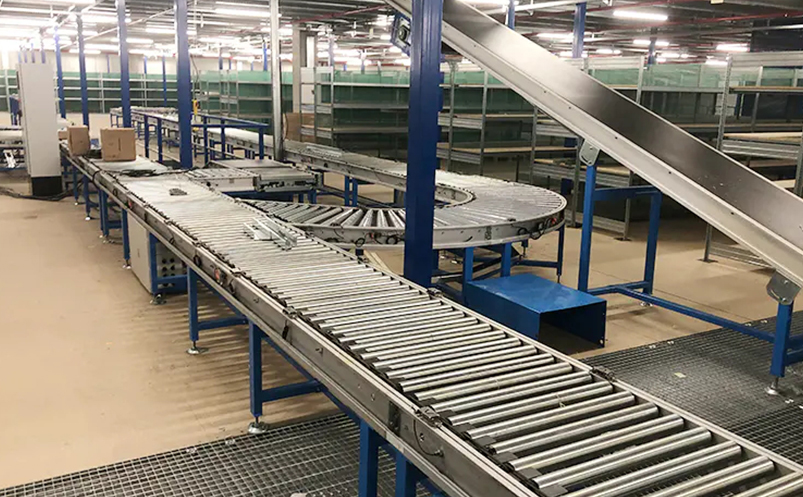
Gravity rollers spin freely while the load moves under a gentle tilt — roughly a one to two percent decline for average cartons — or from an operator's push. There is no motor, no wiring, and little to service, which keeps gravity sections the default at docks, picking zones, and anywhere people work alongside the line. Boxes also queue naturally at the end of a run.
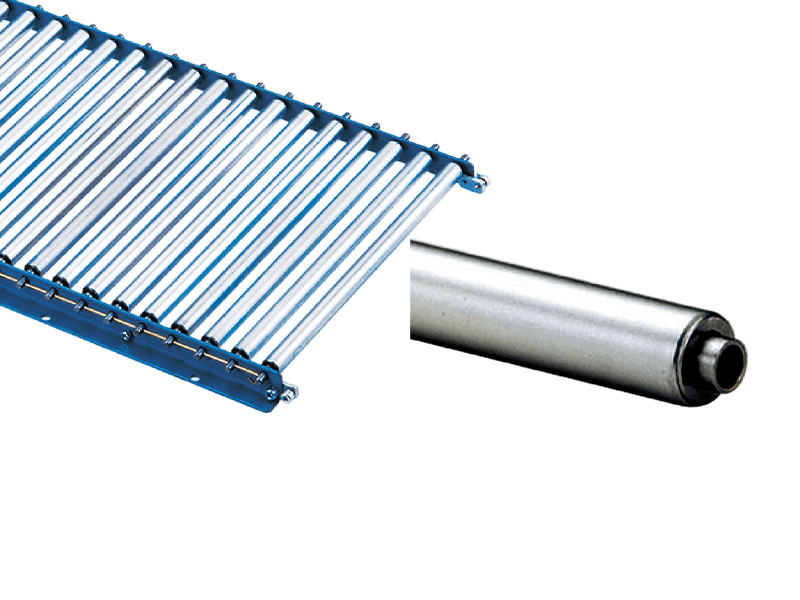 Gravity Roller Conveyor for Flat-Bottom LoadsFree-spinning rollers move cartons on a gentle decline or by a light push, with no motor or wiring to maintain. A simple, low-cost option for docks, picking zones, and areas where workers operate alongside the line.View Product →
Chain-driven roller conveyors
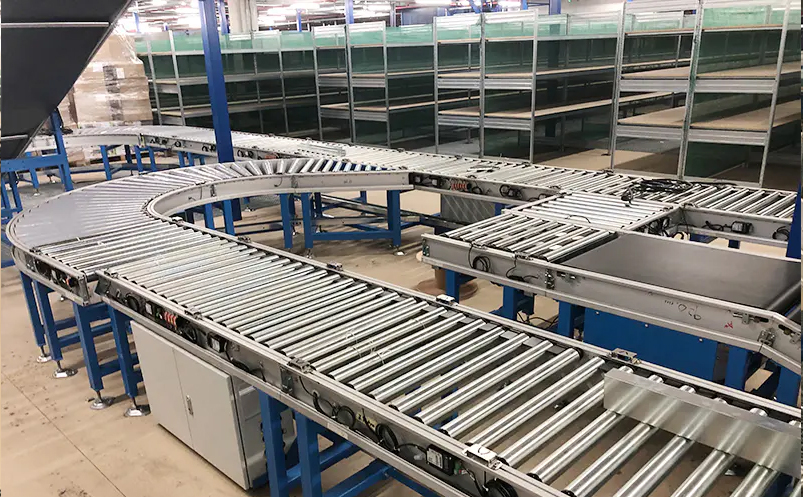
Sprockets on each roller mesh with a chain running beneath the line, so every powered roller turns in unison. That positive drive suits heavy loads — pallets, drums, steel bins — and wet or dusty conditions where friction drives slip. It is also the natural choice wherever loads must move in exact sync, such as transfers and turntables. Trade-offs: higher cost, more noise, and a chain lubrication schedule gravity lines never need.
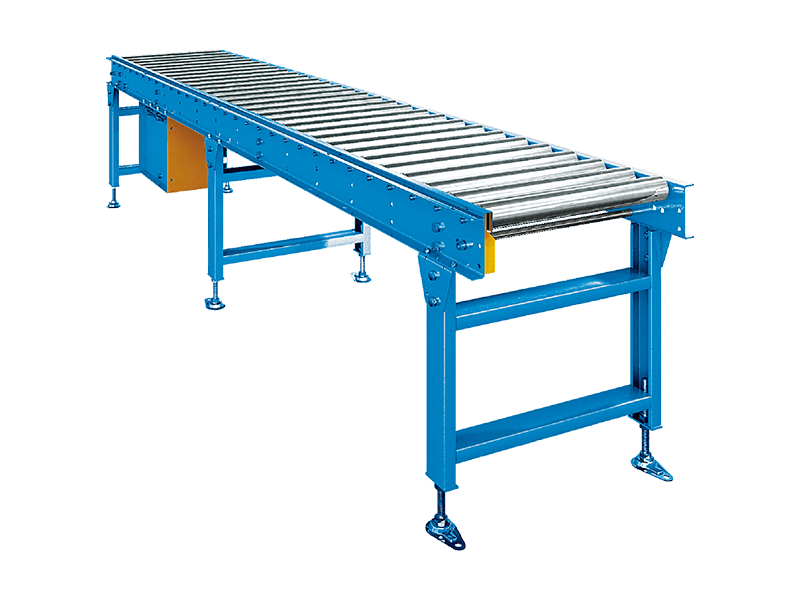 Chain-Driven Roller Conveyor for Heavy LoadsSprockets on each roller mesh with a chain beneath the line, turning all rollers in unison. This positive drive suits pallets, drums, and steel bins, plus wet or dusty conditions where friction drives can slip.View Product →
Belt-driven and O-belt roller conveyors
These designs drive the rollers indirectly: a belt beneath the roller line, or small O-belt loops routed through grooves in each roller, transfer motion by friction. They sit between gravity and chain-driven types in cost and capacity, run noticeably quieter than chain, and handle medium-weight cartons and totes smoothly, which is why they are common in e-commerce distribution buildings.
Motor-driven roller conveyors
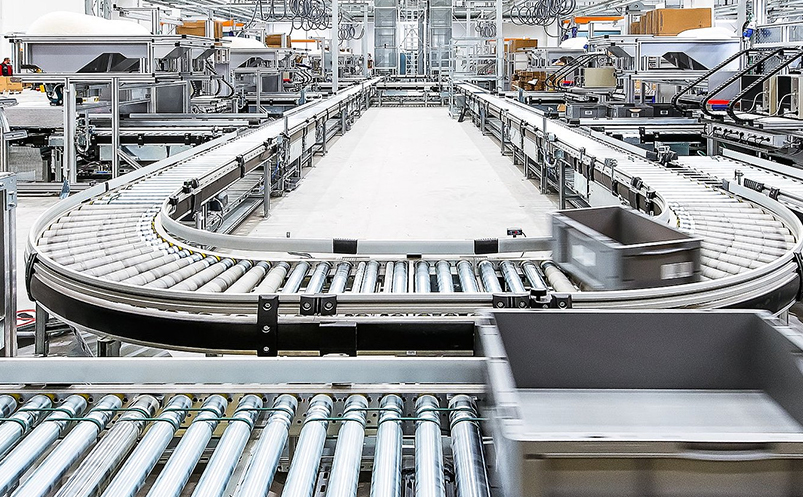
A motorized roller puts the motor and gearbox inside the tube. One motor roller drives adjacent slave rollers through O-belts, forming a powered zone with its own sensor and control card. Zones start and stop independently, so products queue with small controlled gaps instead of shoving each other — zero-pressure accumulation that protects fragile goods. Each zone draws power only while a product is present, which cuts energy use sharply against a continuously running line. When quoting, compare AC and DC motor roller options; DC variants suit soft starts, speed control, and battery power.
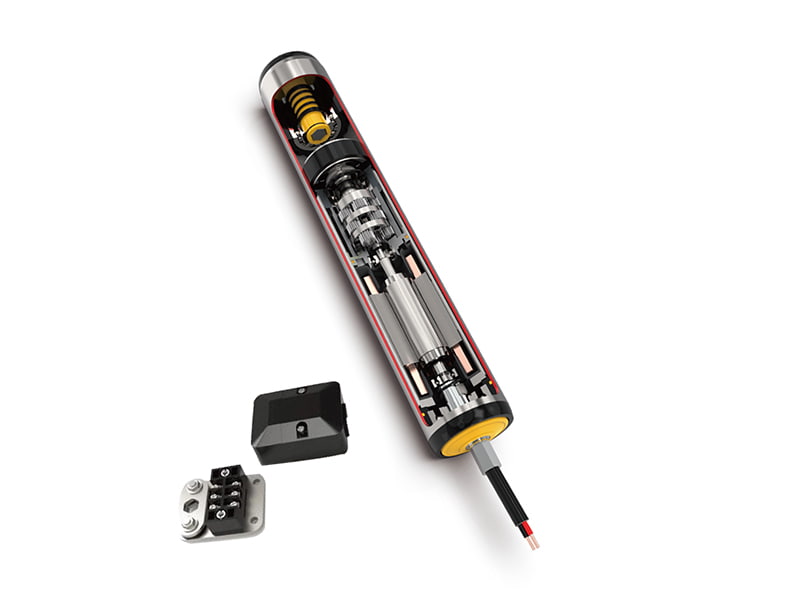 Motor Roller Conveyor with Zoned AccumulationMotors built into the roller tube drive slave rollers via O-belts, forming independent zones that start and stop on demand. Zero-pressure accumulation protects fragile goods while cutting energy use versus continuously running lines.View Product →
Accumulating roller conveyors
Accumulation is a function more than a machine type. Gravity lines accumulate crudely, with products bumping into one another; controlled lines stop the rollers under a queued product while upstream zones keep flowing — the behavior that lets one slow carton back up in a fulfillment center without stalling the line. Designs exist for loads from a few kilograms per carton to several hundred per pallet.
Roller Materials, Curves, and Build Quality
The roller tube is where material choice pays off or backfires:
- Galvanized steel is the standard for dry indoor work — strong, economical, and available in every diameter.
- Stainless steel survives washdowns, salt, and acids, making it the norm in food processing, pharmaceuticals, and cold stores.
- Aluminum keeps medium-duty lines light and easy to reposition while resisting most corrosion.
- Resin rollers run quietly, cannot rust, and cushion scratch-sensitive products.
Curves deserve special attention. A curve built with cylindrical rollers lets the inside corner of a carton drag, so boxes skew sideways; tapered rollers fix this by running their narrow end slower, keeping packages square to the flow. Insist on tapered rollers matched to the curve radius wherever the layout turns.
Two construction details separate a conveyor that lasts from one that limps. Sealed precision ball bearings cost little more than loose bearings and outlast them several times over in real plants. Spring-loaded axles turn roller replacement into a two-minute job with no frame drilling — worth more over ten years than it sounds on a quote sheet.
Where Roller Conveyors Earn Their Keep
The type map follows the industry. E-commerce and distribution centers lean on motor-driven and accumulating lines for zoned transport between picking, packing, and sortation. Assembly plants favor chain and double-speed chain designs that hold a steady pace beside operators. Fruit and vegetable processors specify stainless frames that tolerate daily washdown, airports run roller conveyors through security checkpoints, and heavy industry relies on chain-driven and heavy-load variants because nothing in that environment is gentle.
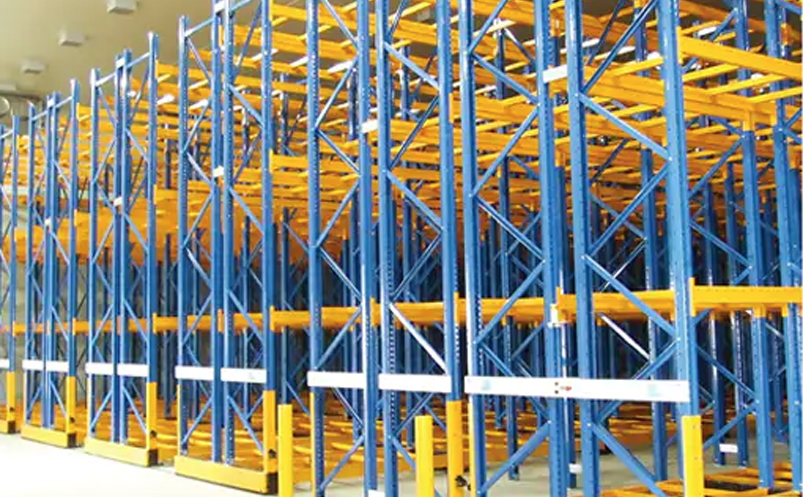
Most real facilities blend profiles: gravity spurs at workstations, powered trunk lines between them. A supplier that manufactures the full range — plus the rollers, drive rollers, and storage racks around the line — can quote a layout as one system instead of selling loose modules that may never match.
How to Specify a Roller Conveyor Without Overpaying
Most specification mistakes trace back to four numbers: the weight and footprint of the smallest load, roller pitch, roller diameter, and width. The rules below are the ones layout engineers apply first.
| Specification | Practical rule | Why it matters |
|---|---|---|
| Roller pitch | At least three rollers under the smallest load at all times; pitch no more than one third of the shortest package length | Wide pitch lets small cartons dip, jam, or tip between rollers |
| Roller diameter | About 35 mm for light cartons, 50 mm for general carton and tote duty, 60 mm and up for heavy cases and pallets | Undersized tubes deflect and wear flat spots into bearings |
| Conveyor width | Load width plus 50 to 100 mm of clearance | Extra width invites packages to rotate and skew through curves |
| Per-roller capacity | Spread the load across the rollers it actually spans, then add margin for impact at transfers | Shock loads, not steady weight, are what break axles |
| Drive type | Gravity for short runs near people; chain-driven for pallets and harsh conditions; motorized zones for automated accumulation | Overdriving wastes energy; underdriving stalls throughput |
| Environment | Stainless or resin for washdown; sealed bearings for dust; explosion-proof certified drives where flammable vapor or dust exists | Environmental mismatch ends equipment life long before metal fatigue does |
One procurement habit saves the most money: price the system over its life, not its invoice. A line built on thin-wall tubes, unsealed bearings, and non-standard rollers is cheap on delivery and expensive by year two, when every replacement becomes a custom order. Ask which tube diameters, axle types, and bearings the manufacturer stocks.
Maintenance That Keeps Rollers Turning
Gravity lines need surprisingly little: walk the line, spin each roller by hand, and replace any that drag, rumble, or wobble — the symptoms of dried or collapsed bearings. Clear away strap shards, tape, and stretch wrap, which wind around axles faster than anything else in a warehouse.
Powered types add a few routines. Chain-driven lines need tension checks and lubrication on a duty-based schedule; gritty plants shorten that interval sharply, and hot environments demand high-temperature grease. Belt-driven lines should have belt tension inspected alongside roller spin, because a slipping belt robs throughput quietly before anything visibly fails. A worn motor roller slides out like a cassette for replacement — one more reason standardized diameters matter at purchase.
Alignment is the quiet destroyer. A frame knocked out of square by a forklift puts edge wear on one side of every roller, surfacing months later as tracking problems and scuffed cartons. Bolt frames down, guard the corners, and re-square any section after an impact.
The Bottom Line for Buyers
Roller conveyors are the most forgiving equipment in a material handling system, provided the drive type matches the load and the rollers match the product. Decide gravity versus powered first, verify pitch and per-roller capacity against your smallest and heaviest items, and treat roller material as an environmental decision rather than a cost decision.
It also pays to buy from a manufacturer that covers the whole chain — carrier rollers, sprocket and tapered drive rollers, motor rollers, complete roller, belt, wheel, and chain conveyor lines, and the racks and sorting systems they feed. Wuxi Huiqian Logistics Machinery Manufacturing works across exactly that range, and its roller conveyors hold EETI explosion-proof certification for installations where flammable vapor or dust rules out standard drives. Send your load dimensions, weights, and a layout sketch through a quote request, then judge the response: a pitch-and-drive recommendation is worth keeping; a bare price list is not.