

 ENG
ENG 中文简体
中文简体 русский
 Français
 Español
 日本語
日本語 عربى
عربىContent
An 800 kg pallet of castings will not roll on a gravity conveyor, and a tray of glass vials should never be asked to try. Most conveyor purchasing decisions live between those two extremes: the moment a load is too heavy, too fragile, or too time-critical to move on momentum alone, the line needs power delivered to the rollers under control.
The conclusion for buyers is easy to state. Specify a driven conveyor whenever the process needs controlled speed, level or uphill transport, accumulation, or precise start-and-stop timing; keep gravity conveyor for decline spurs, pick modules, and staging lanes where cost matters more than control. The sections below set out which drive type suits which load, what each option costs in maintenance, and which figures to confirm before you request a quote.
What "Driven" Means in Conveyor Terms
A driven conveyor, also called a powered or live conveyor, turns its rollers, belt, or chain with a motor instead of relying on the product's own momentum. Long lines are usually built from two module types: drive sections, which hold the motor and transmission, and slave (idler) sections, which carry the load while receiving motion from the nearest drive. One drive can pull one or more slave sections, so line length, curve count, and product weight directly determine how many drives a layout requires.
Power reaches the carrying surface through four common routes: a chain driving sprocketed rollers, an O-ring or poly-vee belt running beneath the rollers, a friction or tangential belt, or a motor sealed inside the roller tube itself. The route you choose changes the noise level, the price, the maintenance schedule, and the load ceiling of the whole line, which is why it deserves more attention than the frame or the paint.
The Main Drive Types and Where Each Fits
Chain-driven live roller
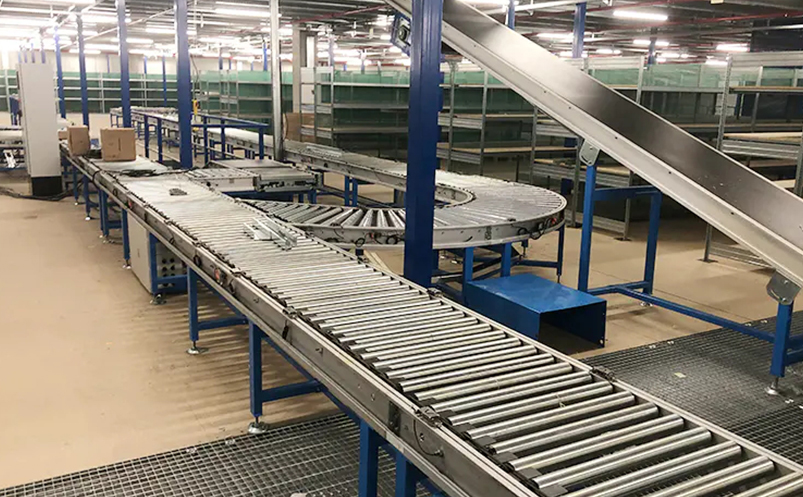
Chain-driven live roller (CDLR) conveyor is the workhorse for heavy loads. Sprockets on each roller are linked by chain, so torque is transmitted positively and nothing slips when a pallet lands hard or starts against a stop. That makes CDLR the default for palletized goods, drums, dies, and machined castings, commonly from a few hundred kilograms to several tonnes per pallet. The trade-offs are higher noise, periodic chain tensioning and lubrication, and a steeper initial price than belt-driven equivalents.
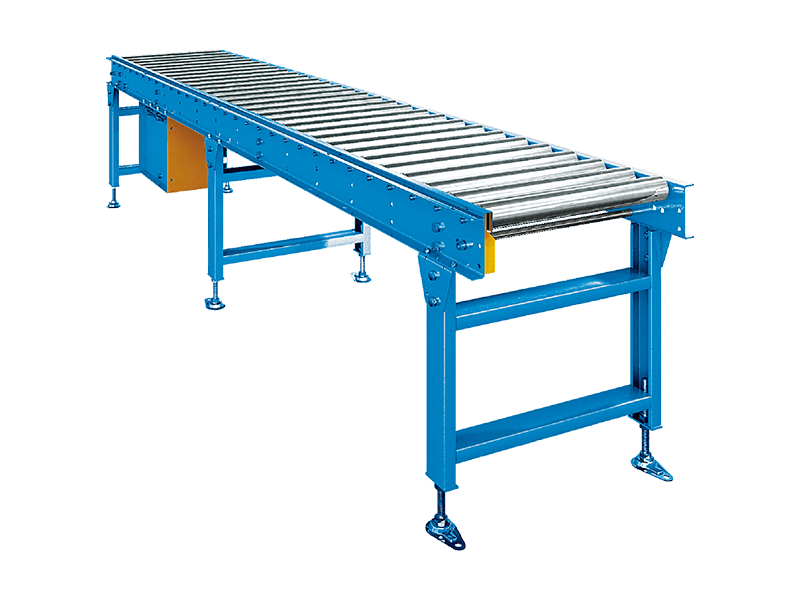 Chain-Driven Live Roller Conveyor for Heavy Palletized LoadsCDLR conveyors use sprockets and chain to transmit torque positively, so nothing slips when heavy pallets, drums, or machined castings land hard. This supplier offers single and double sprocket models in multiple roller sizes.View Product →
O-belt and poly-vee driven roller
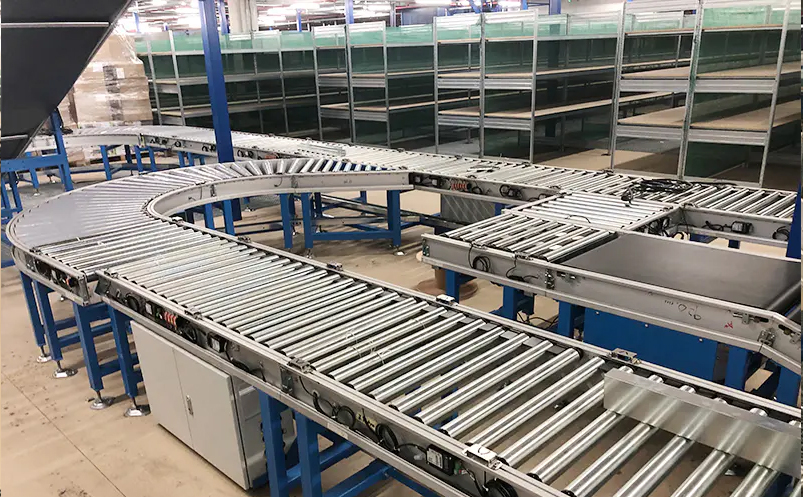
In an O-belt or poly-vee driven roller conveyor, a small belt beneath the rollers couples a shaft or motor to each roller. These lines run quieter than chain drives, carry cartons, totes, and light pallets in the tens to low hundreds of kilograms, and adapt naturally to accumulation because zones can disengage individually. Two practical requirements follow: loads need a flat, reasonably rigid bottom so the rollers can grip, and drive belts are wear items that should be ordered as spares from day one.
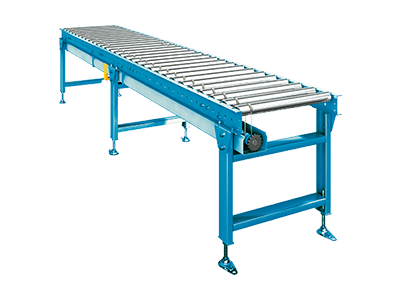 O-Belt Drive Roller Conveyor for Cartons and TotesAn O-ring rubber belt driven from a shaft powers each roller, giving quiet, stable transport for lightweight flat-bottomed items. Belt-driven zones disengage individually, making this conveyor a natural fit for accumulation lines.View Product →
Motorized roller conveyors
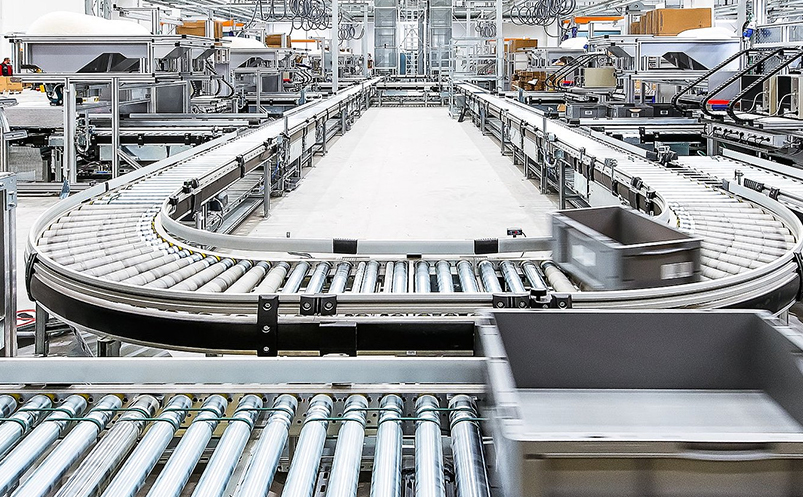
A motorized roller is a drum motor with the motor and gearbox sealed inside the tube, so every powered roller becomes an independently controllable zone. Low-voltage DC versions dominate modern fulfillment and distribution systems because they draw power only when product is present, connect with plug-in cabling rather than chain guards and pneumatic lines, and retrofit into existing frames. They are the standard answer for zero-pressure accumulation, where cartons queue with gaps and sensors release them one by one.
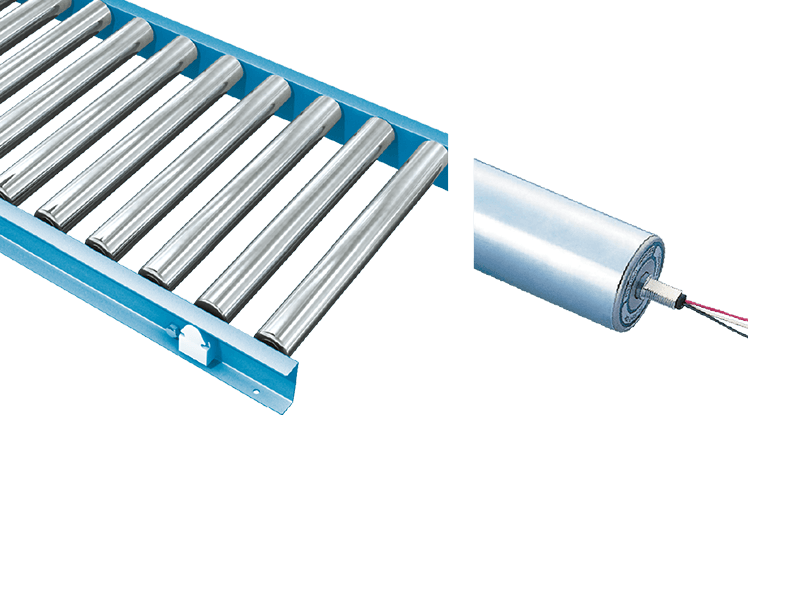 Electric Motor Roller Conveyor with Built-in Drum Motor DriveEach roller integrates a sealed motor and gearbox, so it works as an independently controllable zone without extra drive space. DC versions suit zero-pressure accumulation in fulfillment systems and retrofit into existing frames.View Product →
Slat-top chain and double-speed chain
Slat-top chain conveyors carry product on linked steel or plastic plates and hold a fixture position precisely, which suits bottling lines and assembly stations that lock jigs to the chain. Double-speed chain conveyors run workpiece pallets faster than the surrounding line pace, so an operator can work at a station while the next pallet waits just behind. This is a standard pattern in automotive and appliance final assembly, where the conveyor itself becomes part of the production rhythm.
Drive Types at a Glance
The table below condenses the choice into the three columns that actually drive cost: what the drive can carry, what it does best, and what it will ask of your maintenance team.
| Drive method | Typical load range | Best suited to | Points to watch |
|---|---|---|---|
| Chain-driven live roller | Pallets, drums, and castings from a few hundred kg to several tonnes | Pallet handling, heavy machining, hot or abrasive loads | Chain tensioning, lubrication, noise |
| O-belt / poly-vee driven roller | Cartons, totes, and light pallets, roughly 20-300 kg per item | Distribution flow, curves, minimum-pressure accumulation | Belt wear; loads need flat, rigid bottoms |
| Motorized roller zones | Cartons and totes, controlled zone by zone | Zero-pressure accumulation, fulfillment, retrofits | Sealed electronics need protection from dust and washdown |
| Slat-top / double-speed chain | Fixed fixtures and assemblies | Assembly stations, bottling, food washdown | Higher initial cost; chain tracking must be set correctly |
No row wins outright. A washdown food plant weights stainless slat chain and sealed motors highest, a palletizing cell weights chain-driven rollers, and a fulfillment center almost always settles on motorized zones.
What to Confirm Before You Order
Drive type is only half the decision; the specification you send to the manufacturer determines whether the line meets rate on day one. Six items repay the effort:
- Real load data. Record the heaviest and lightest items, their footprints, and the condition of the bottom surface. A roller line needs at least three rollers under the load at all times, and soft or uneven bottoms push the choice toward belt.
- Rate and speed. Required cartons or pallets per hour set roller pitch, drive count, and whether the line needs zones at all.
- Accumulation logic. Minimum-pressure lines let products touch; zero-pressure lines preserve gaps. Sensitive products and controlled release to workstations call for zero-pressure.
- Environment. Temperature, dust, washdown chemicals, and explosive atmospheres all narrow the materials and motor options. Certifications matter here; for example, Wuxi Huiqian's roller conveyors carry EETI explosion-proof certification for use in hazardous areas.
- Controls integration. Confirm sensor types, supply voltage, and the handshake with your PLC or warehouse system before fabrication, not after installation.
- Spares strategy. Chains need lubrication and periodic tensioning, belts are consumables, and brushless DC rollers mostly need bearing checks. Ask what the manufacturer stocks and at what lead time.
For the engineering detail behind these choices, the explainer on how power is transmitted to driven rollers in a conveyor walks through the chain, belt, and motor-in-roller paths step by step.
Where Driven Conveyors Earn Their Cost
The payback concentrates in four recurring situations. E-commerce and parcel operations use accumulating roller lines and motorized zones to merge order waves without product-to-product contact, protecting labels and contents while keeping downstream sorters fed at a steady rate.
Assembly plants use double-speed chain and slat-top systems to hold stations in step, so takt time survives shift changes and model mix. Food processors run washdown-rated lines through washing, grading, and packing; an automated fruit and vegetable line, for instance, holds a crate rate that manual handling cannot sustain across a full shift. Airport checkpoints depend on powered roller lanes because tray return must continue regardless of what the passenger does, a duty that gravity hardware cannot guarantee.
In the end, the decision is a matching exercise. Gravity remains the cheapest way to move a willing load downhill; driven conveyor exists for everything that must move on schedule. Write down the true heaviest and lightest loads, the rate you must hold, the environment the line will face, and the accumulation behavior you expect, then match those to chain for tonnage, belts for quiet mid-range flow, and motorized rollers for zoned control. Wuxi Huiqian manufactures the rollers, the drives, and the complete lines in-house, which keeps these trade-offs in one quotation instead of three.