

 ENG
ENG 中文简体
中文简体 русский
 Français
 Español
 日本語
日本語 عربى
عربىContent
- 1 What Are Roller Conveyors and Why Does the Type Matter?
- 2 Main Types of Roller Conveyors by Drive Mechanism
- 3 Types of Roller Conveyors by Roller Material and Construction
- 4 Specialized Roller Conveyor Types for Specific Industry Needs
- 5 How to Choose the Right Roller Conveyor for Your Industry
- 6 Industry-Specific Roller Conveyor Recommendations at a Glance
What Are Roller Conveyors and Why Does the Type Matter?
Roller conveyors are material handling systems that use a series of rotating cylinders — called rollers — mounted in a frame to move goods from one point to another. They are foundational to modern manufacturing, warehousing, distribution, and logistics operations worldwide. Choosing the wrong type, however, leads to product damage, excessive energy consumption, and costly maintenance. The right roller conveyor type can reduce handling time by up to 40% and cut labor costs significantly, making the selection decision critical for any industrial operation.
Roller conveyors are broadly categorized by their drive mechanism, roller material, frame orientation, and application environment. Understanding these distinctions is the foundation of a smart procurement decision.
Main Types of Roller Conveyors by Drive Mechanism
Gravity Roller Conveyors
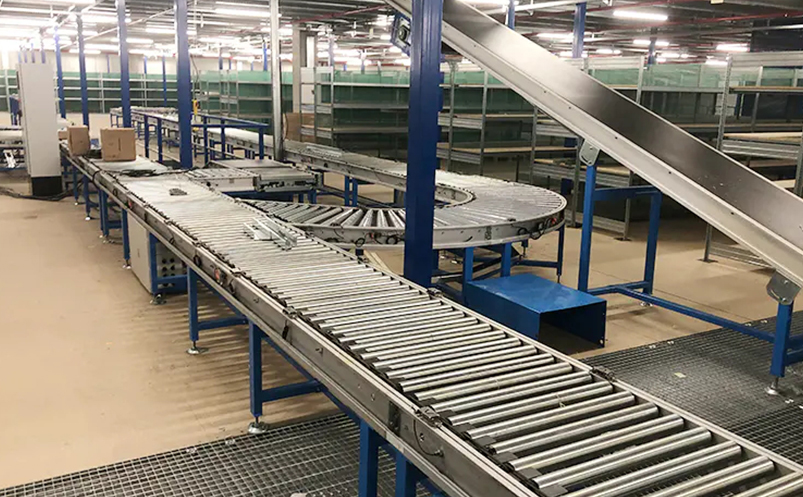
Gravity roller conveyors rely entirely on incline and the product's own weight to move goods along the line — no motor required. They are among the simplest, lowest-cost conveyor solutions available. Common applications include:
- Loading docks for unloading cartons and totes
- Assembly lines where operators manually push products forward
- Short-distance transfers between workstations
- Shipping and receiving areas in e-commerce warehouses
Key advantage: Zero energy cost during operation. Key limitation: Requires a slope of typically 3°–5° and is unsuitable for incline conveying or precise speed control.
Powered (Belt-Driven) Roller Conveyors
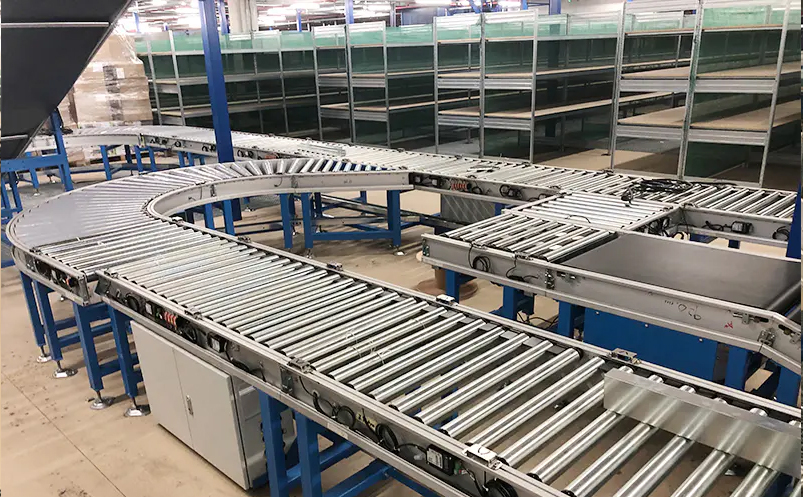
Powered roller conveyors use a motorized belt running beneath or between the rollers to drive product movement horizontally or even slightly uphill. They offer consistent, controllable speed — typically between 10 and 100 feet per minute — and are the workhorse of most automated fulfillment centers.
Belt-driven live roller (BDLR) conveyors are especially popular because the belt can slip beneath rollers without risk to products if a jam occurs, acting as a natural clutch mechanism. This makes them suitable for fragile or irregularly shaped goods.
Chain-Driven Roller Conveyors
Chain-driven conveyors use heavy-duty roller chains to directly turn each roller in the frame. They excel in heavy-load and high-temperature environments where belt materials would degrade. Typical load capacities range from 500 lbs to over 10,000 lbs per section, making them standard in:
- Automotive assembly plants (engine blocks, transmissions)
- Steel mills and foundries
- Pallet handling and industrial drum conveyance
Zero-Pressure Accumulation (ZPA) Roller Conveyors
ZPA conveyors are an advanced variant of powered roller systems where individual zones can be independently stopped and started. Products accumulate on the conveyor without touching each other — eliminating back-pressure damage. This is the preferred type for fragile goods, barcode scanning stations, and high-throughput order fulfillment systems. Modern ZPA systems use 24V DC motorized rollers (MDRs) for zone-level control, low noise, and energy savings of up to 50% compared to traditional AC motor systems.
Motorized Drive Roller (MDR) Conveyors
MDR conveyors embed a 24V DC brushless motor inside the roller itself. Each zone of typically 3–5 rollers is powered by one motorized roller driving its neighbors via O-rings or poly-V belts. Benefits include:
- Near-silent operation (under 65 dB)
- Plug-and-play installation and zone replacement
- Integration with WMS and PLC systems via I/O or fieldbus protocols
- Safe low-voltage operation suitable for collaborative robot environments
Types of Roller Conveyors by Roller Material and Construction
Beyond the drive mechanism, roller material determines suitability for specific environments and product types.
| Roller Material | Best For | Not Suitable For | Typical Industries |
|---|---|---|---|
| Carbon Steel (Galvanized) | Heavy loads, general industry | Wet/corrosive environments | Manufacturing, Automotive |
| Stainless Steel (304/316) | Washdown, FDA compliance | Very high-load abrasive products | Food & Beverage, Pharma |
| PVC / Plastic | Lightweight, quiet conveying | High temperatures, heavy loads | E-commerce, Retail DC |
| Rubber-Coated Steel | Fragile or polished surfaces | Sharp-edged products | Glass, Electronics, Printing |
| Aluminum | Corrosion resistance + light weight | Very heavy loads | Aerospace, Clean Room |
Specialized Roller Conveyor Types for Specific Industry Needs
Pallet Roller Conveyors
Designed with heavy-gauge steel frames and wide-pitch rollers (typically 6–12 inch centers), pallet conveyors handle standard GMA pallets (48" × 40") and euro pallets. They integrate with pallet lifters, turntables, and stretch wrappers in automated pallet handling lines. A robust pallet conveyor system can process 60–120 pallets per hour in a high-throughput distribution center.
Curved Roller Conveyors
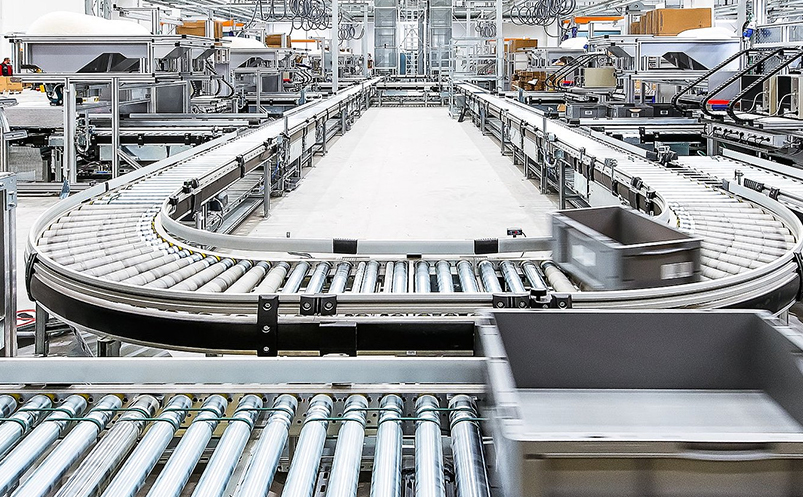
Standard 90° and 45° curved sections use tapered rollers — wider at the outer rail, narrower at the inner — to guide products around corners without lateral drift. This eliminates the need for right-angle transfers in many layouts and is essential for loop conveyor systems found in airports, post offices, and large fulfillment centers.
Expandable / Flexible Roller Conveyors
These accordion-style conveyors can be compressed for storage and extended up to 4–5 times their collapsed length. Constructed from aluminum or steel with nylon rollers, they are indispensable for:
- Truck and trailer loading/unloading
- Temporary production overflow lines
- Trade show and event logistics
- Pop-up distribution operations during peak seasons
Sanitary / Hygienic Roller Conveyors
Built to meet FDA, USDA, EHEDG, and 3-A Dairy standards, sanitary conveyors feature stainless steel frames with open-leg designs, crevice-free welds, and IP69K-rated sealed bearings. All surfaces are sloped for drainage, and rollers are removable without tools for full CIP (clean-in-place) or COP (clean-out-of-place) washdown. These are non-negotiable in raw meat processing, dairy, fresh produce, and pharmaceutical tableting environments.
High-Temperature Roller Conveyors
For operations like glass annealing lehr lines, ceramic kilns, paint curing ovens, or powder coating systems, conveyors must withstand continuous temperatures from 200°C to over 600°C. These units use heat-treated steel rollers, graphite-lubricated bearings, and alloy drive components rated for sustained thermal stress.
How to Choose the Right Roller Conveyor for Your Industry
Selecting the optimal roller conveyor requires evaluating six core parameters before contacting a supplier:
- Product characteristics — weight, dimensions, base type (rigid/flexible/irregular), fragility, temperature sensitivity
- Throughput requirements — units per hour, peak vs. average volumes, surge capacity needs
- Layout constraints — available floor space, ceiling height, incline/decline requirements, number of turns
- Environment — temperature range, humidity, presence of chemicals, dust, or water; cleanroom classification if applicable
- Automation integration — barcode scanning, vision systems, robotic pick stations, WMS/WCS connectivity requirements
- Budget and lifecycle cost — initial capital vs. operating cost (energy, maintenance, spare parts availability)
For general-purpose warehousing with mixed carton sizes, MDR-based ZPA conveyors represent the current industry best practice — balancing energy efficiency, product safety, and automation-readiness. For heavy industrial applications with loads exceeding 1,000 lbs, chain-driven systems remain the most reliable long-term solution.
When in doubt, request a system simulation or throughput analysis from your conveyor supplier before committing to a design. Reputable manufacturers will model your operation using digital twin software to validate system performance before a single component is manufactured.
Industry-Specific Roller Conveyor Recommendations at a Glance
E-Commerce and Retail Distribution
MDR ZPA conveyors with plastic rollers, integrated barcode scanners, and divert sorters. Speed: 60–120 fpm. Volume-flexible designs with modular 24V zones for rapid reconfiguration during peak seasons.
Food and Beverage Processing
Stainless steel sanitary conveyors with sealed bearings, washdown motors, and HACCP-compliant design. Paired with metal detection and checkweigher integration at critical control points.
Automotive Manufacturing
Heavy-duty chain-driven pallet conveyors for powertrain assembly, combined with precision MDR lines for electronics and trim assembly. Overhead inverted roller conveyors for body-in-white painting lines.
Pharmaceutical and Medical Device
Cleanroom-grade aluminum or stainless conveyors with low-particle-emission components, antistatic treatments, and full traceability integration. ESD-safe roller coatings for sensitive electronics handling.
Airports and Courier Hubs
High-speed flat belt and tapered roller systems for baggage and parcel handling, capable of 200+ fpm with integrated RFID, 360° barcode tunnels, and automatic exception lanes.