

 ENG
ENG 中文简体
中文简体 русский
 Français
 Español
 日本語
日本語 عربى
عربىContent
What an Airport Conveyor Line Actually Has to Handle
A mid-size hub can push 1,500 to 2,000 bags an hour through its system during peak departure banks, and that volume has to keep moving with almost no tolerance for downtime. A stopped conveyor at check-in backs up the entire terminal queue; a stopped conveyor in sortation means bags miss their flights. The equipment behind that line has to run continuously across shifts, handle everything from a soft duffel to an oversized golf bag, and do it without damaging either the baggage or itself.
That combination of constant duty cycles, mixed load shapes, and zero-tolerance timing is why airport baggage systems rarely use one type of conveyor throughout. Different stretches of the line call for different mechanics, and the choice between belt and roller technology usually comes down to what each section of the journey actually needs to do.
Continuous Belt Transport for the Long, Flat Runs
The long straight runs between check-in and the sortation hall, and again between sortation and the aircraft loading area, are where belt conveyors do most of the work. A continuous fabric or rubber surface carries bags without the small gaps between rollers that can catch straps, wheels, or loose fabric, which matters when a single snagged bag can shut down an entire lane. Standard type belt conveyors designed for continuous, flat transport handle exactly this kind of run, moving baggage steadily over long distances at a fixed speed.
Flat, uninterrupted contact also keeps irregular items stable. A soft-sided bag or an odd-shaped case sits more securely on a belt than it would rolling across a series of independent rollers, which reduces the chance of it shifting or falling during transport.
Curves, Merges, and Direction Changes Without Losing Speed
Terminal layouts are rarely straight lines. Baggage systems have to route around structural columns, merge flows from multiple check-in banks into one sortation feed, and redirect bags toward different concourses, all without forcing the line to slow down at every turn. Turning belt conveyors that redirect flow without breaking momentum handle these direction changes on the belt side, using a curved bed to keep baggage centered through the bend.
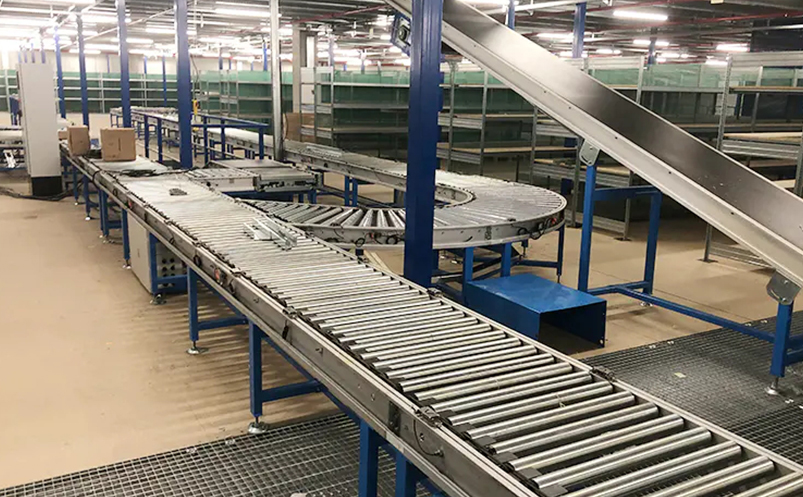
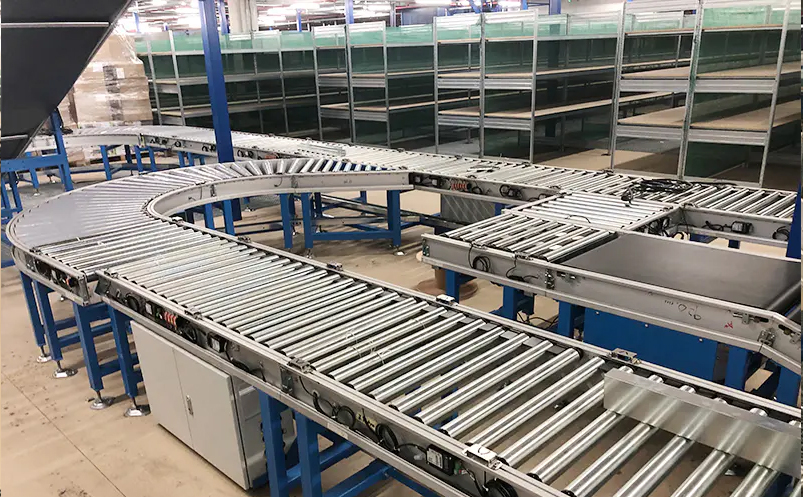
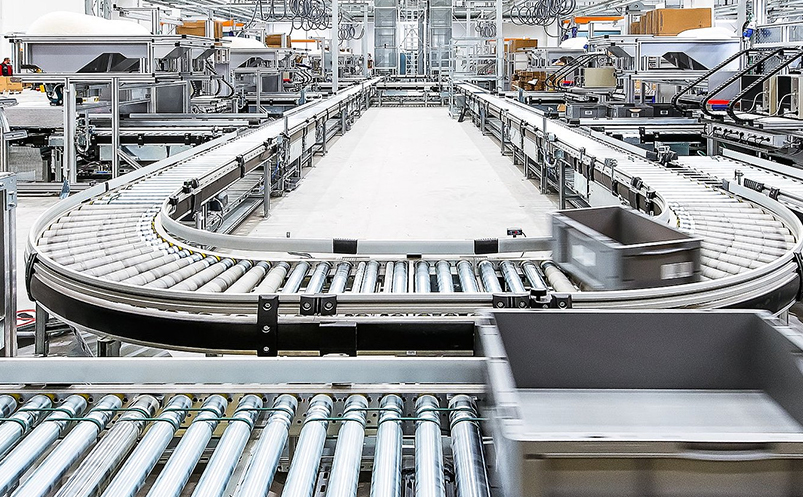
On the roller side, curved sections need a different geometry. Because a roller conveyor's speed is set by roller rotation rather than a continuous surface, the outer edge of a curve has to move faster than the inner edge for baggage to travel through it without spinning or jamming. Taper roller conveyors built for smooth curved transitions solve this with cone-shaped rollers that vary their effective diameter across the width of the conveyor, matching that speed difference automatically.
Built for Round-the-Clock Reliability
Reliability in this environment isn't about avoiding failure altogether, since any mechanical system with this many moving parts will eventually need service. It's about how much load the drive components can absorb before that happens, and how predictable the maintenance schedule is. Chain-driven roller conveyors engineered for continuous duty cycles are built around that expectation, using positive mechanical engagement rather than friction alone, which keeps performance consistent even after tens of thousands of operating hours.
Heavier baggage adds another layer to that requirement. Oversized cases, sporting equipment, and musical instrument crates put considerably more stress on a conveyor than a standard suitcase, and undersized equipment wears out fast under that kind of load. Heavy-load chain driving roller conveyors for oversized or heavy baggage are sized specifically for this segment of the flow, so the system doesn't have to compromise its overall speed just to accommodate the occasional oversized item.
Balancing speed and reliability, in practice, comes down to matching each stretch of the line to the mechanics it actually needs rather than running one conveyor type end to end.