

 ENG
ENG 中文简体
中文简体 русский
 Français
 Español
 日本語
日本語 عربى
عربىContent
Gravity stops working the moment your floor levels out. That's the real reason facilities upgrade to a motorized conveyor—not because gravity conveyors are bad, but because they only function on a slope. Once you need consistent, controllable movement on flat ground, you need a motor driving the rollers. The question is which configuration actually fits your operation.
What Sets a Motor Roller Conveyor Apart
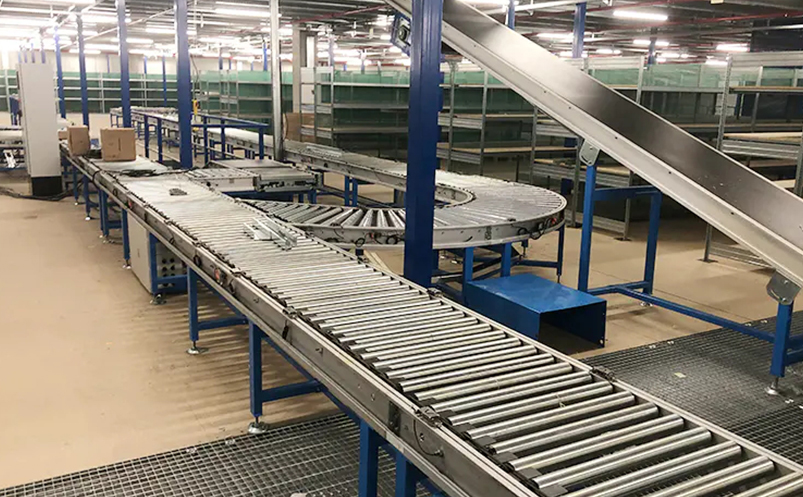
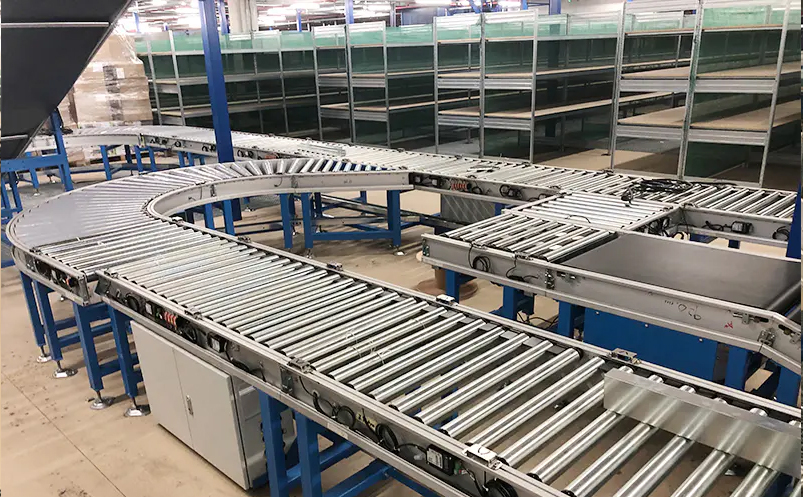
A motor roller conveyor integrates the drive motor directly inside the roller tube rather than attaching an external gearbox or motor to the conveyor frame. This design eliminates the bulky drive unit that traditional powered conveyors require, which translates to a noticeably smaller footprint—critical in packaging lines, assembly cells, and distribution centers where floor space is expensive.
Because the motor is sealed inside the roller, noise levels drop significantly compared to chain-driven alternatives. The system also draws power only when loads are present (using photo-eye sensors), which cuts idle energy consumption without any additional programming.
AC vs. DC: The Drive Decision That Defines Performance
Both AC and DC motor rollers use the same compact form factor, but they behave differently under load—and choosing the wrong one creates problems that are difficult to fix after installation.
AC motor rollers (such as the SST-57A and SST-60A series) suit light, flat, evenly distributed cargo. They are straightforward to wire, compatible with standard industrial power supplies, and cost-effective for operations where speed doesn't need to vary. If your line runs one product type at a consistent weight, AC is a solid, economical choice.
DC motor rollers (the DC-57 and DC-60 series) deliver constant torque regardless of load fluctuation, making them the better option when cargo weight varies or when soft-start/stop control is needed to protect fragile goods. DC voltage also allows speed adjustment without auxiliary controllers, which simplifies the overall system architecture. For most mixed-product or e-commerce fulfillment environments, DC is the more versatile investment.
Three Drive Modes—and When to Use Each
Within both AC and DC lines, electric motor roller conveyors are available in three drive configurations that determine how the powered roller transmits motion to its neighbors.
| Drive Mode | Mechanism | Best For | Example Models |
|---|---|---|---|
| Single Action | Motor roller drives load directly; no belt linking adjacent rollers | Short zones, precise positioning | SST-57A / DC-57A |
| PU V-Belt | Polyurethane V-belt connects motor roller to passive rollers in the zone | Smooth, quiet transport; light-to-medium loads | SST-57B / DC-57B, SST-38D / DC-38D |
| #40 Sprocket | Chain links motor roller to adjacent rollers | Heavier loads; robust industrial environments | SST-57C / DC-57C |
The 38mm roller diameter variants (SST-38D / DC-38D) are dimensionally smaller, suited for narrow conveyors handling compact items. The 57mm and 60mm diameter options handle standard industrial loads and are interchangeable across most conveyor frames of the same pitch.
Load Capacity and Speed: Getting the Numbers Right
Standard motorised roller conveyors in the 57–60mm class handle per-zone loads up to approximately 45 kg (100 lbs), which covers the majority of parcel and packaging applications. Industry-grade heavy-duty configurations with sprocket drives can exceed 1,700 kg (3,900 lbs) per zone for pallet-level loads. Conveyor speed typically ranges between 18 m/min and 60 m/min (60–200 FPM) on standard settings, with variable-speed DC units adjustable outside this band.
One specification buyers frequently overlook: roller spacing. The general rule is one powered roller for every two to three passive rollers in a zone, depending on cargo weight and surface friction. Under-spacing powered rollers wastes cost; over-spacing creates slip and uneven transport. Match roller centers to the shortest product dimension—the item must always contact at least three rollers simultaneously.
Where Motorised Roller Conveyors Deliver the Most Value
The strongest use cases for AC-powered motorised roller systems include stamping and assembly lines with uniform products and fixed-speed requirements. DC motor roller conveyors dominate in e-commerce fulfillment centers and warehouse sortation lines, where products vary and zones need independent start/stop control.
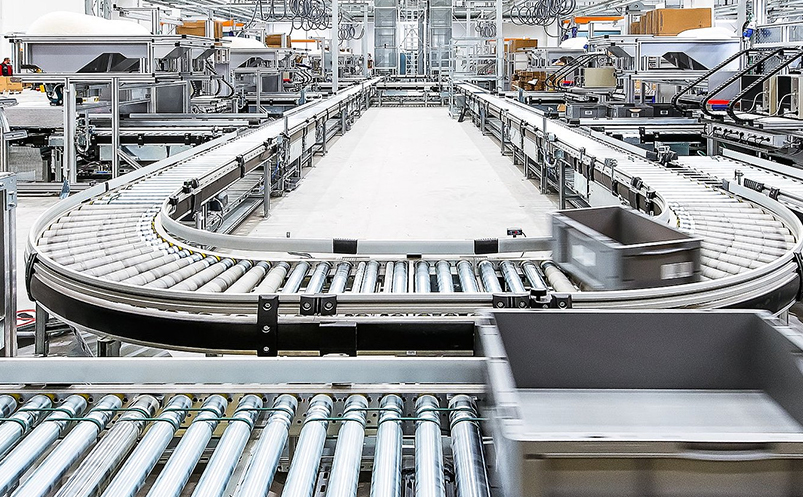
Both types integrate cleanly with accumulating roller conveyor sections to create zero-pressure accumulation buffers—allowing items to queue without back-pressure damage. This combination is the backbone of modern automated sorting lines.
Three Mistakes to Avoid Before You Buy
- Voltage mismatch: Confirm whether your facility runs 50 Hz or 60 Hz power. AC motor rollers are frequency-sensitive; a mismatch directly affects speed and torque. DC units with external power supplies are immune to this issue.
- Ignoring roller spacing rules: Buying to conveyor width only, without calculating roller pitch against minimum product footprint, is the most common cause of conveyor underperformance after installation.
- Skipping zone accumulation planning: A straight motorized conveyor without zone control is just a belt conveyor with higher unit cost. Map your accumulation zones before specifying roller models—this determines how many photo-eye sensors and driver cards you actually need.
Motorized and motorised roller conveyors aren't interchangeable terms for the same product—the right configuration depends on load, speed, environment, and how much zone-level control your process demands. Getting these parameters right before ordering saves weeks of rework. The AC/DC split, drive mode selection, and roller diameter are the three decisions that determine whether your conveyor runs reliably for a decade or becomes a maintenance problem in the first year.