

 ENG
ENG 中文简体
中文简体 русский
 Français
 Español
 日本語
日本語 عربى
عربىContent
Gravity Stops Here: Why Driven Conveyors Run the Show
A gravity conveyor moves product only if you tilt the floor — useful for short runs, not for a 50-meter production line. A driven conveyor solves that problem by putting a motor in the equation. Power is transmitted to rollers or chains continuously, which means you control the speed, the direction, and the accumulation behavior, regardless of elevation or load weight.
That control is exactly what separates a functioning production line from a bottlenecked one. The question isn't whether to use a driven conveyor — it's which drive mechanism matches your specific load, speed, and environment. There are five main types worth knowing, and each has a distinct sweet spot.
The 5 Core Drive Mechanisms Explained
1. Chain Driving Roller Conveyor
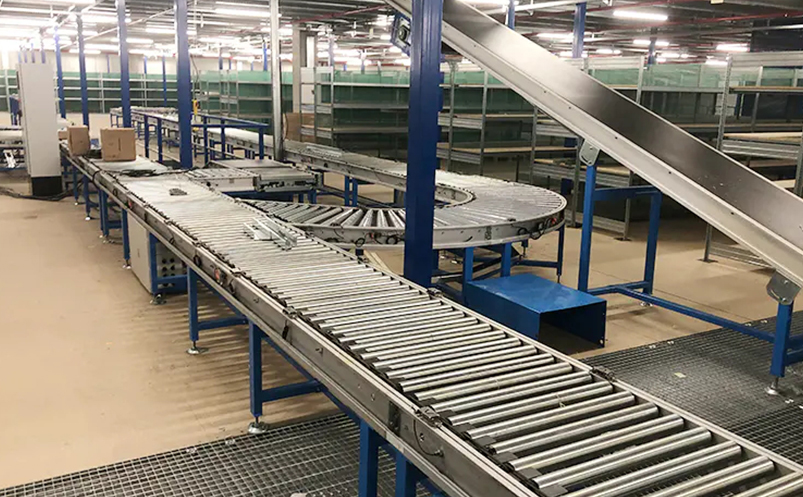
A chain drive connects all rollers mechanically via a sprocket-and-chain system, giving every roller the same consistent torque. This makes it the natural choice for heavy or irregularly shaped loads — pallets, engine blocks, automotive frames — where you need brute reliability over finesse. The HKR-S series, for example, covers roller widths from 300 mm to 800 mm with roller diameters starting at 38 mm, scaling up to handle serious industrial throughput. Maintenance is straightforward: inspect the chain tension periodically and lubricate on schedule.
2. Accumulating Roller Conveyor
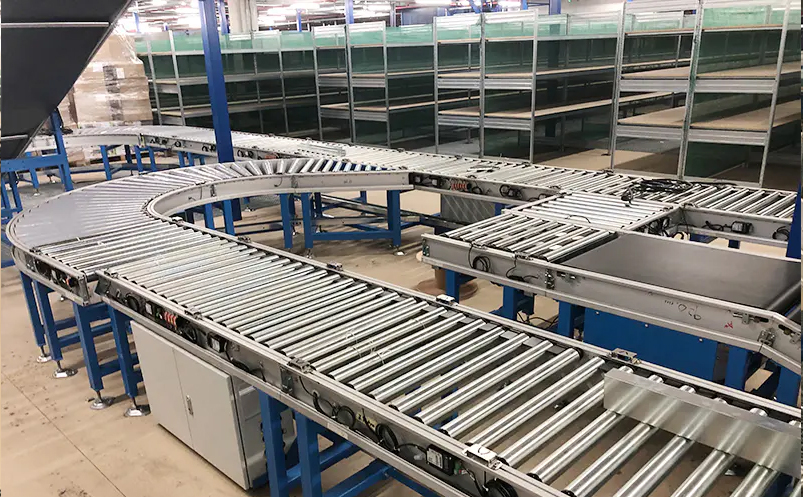
This is where the design gets clever. The accumulating roller conveyor with friction-clutch transmission allows individual rollers to stop turning when a product backs up — without stopping the entire line. The MAC-C Series uses a chain-driven friction clutch so products queue in zero-pressure accumulation zones: no product collisions, no jams, no manual intervention. For e-commerce fulfillment centers or any system with variable output rates, this is often the most valuable type on the floor.
3. O-belt Drive Roller Conveyor
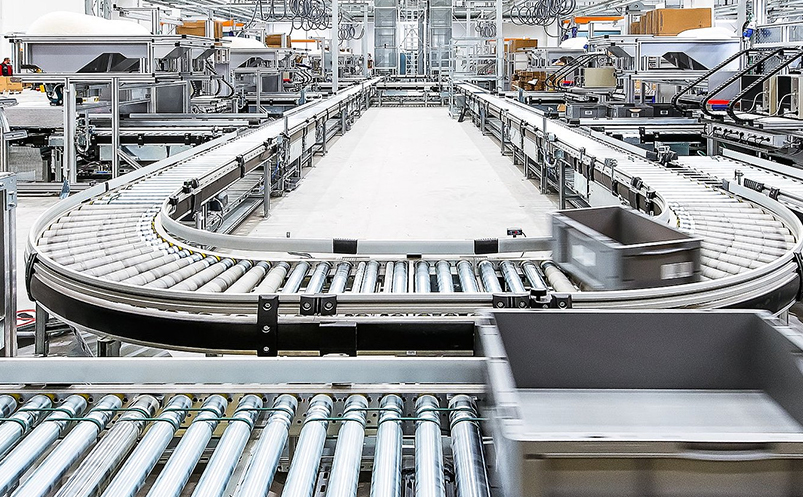
O-belt systems replace metal chains with small round belts looped under each roller. The result is noticeably quieter operation and smoother product handling — a real advantage when you're moving light packages, electronics, or anything that rattles easily. The HMMC series is the go-to here. Noise levels drop significantly compared to chain-driven alternatives, and the O-belt is simpler to replace when worn. Trade-off: it's not built for high-tonnage applications. Use it where smooth, gentle movement matters more than raw pulling force.
4. Slat (Top) Chain Conveyor
Where rollers don't work — oddly shaped items, flexible packaging, products that need a flat, stable surface — slat conveyors step in. The BCT series uses top chain widths from 76.2 mm to 190.5 mm with an aluminium frame option, providing a continuous moving platform rather than a series of rotating points. Common in bottling lines, food processing, and assembly stations where components need to sit flush during transport.
5. Double Speed Chain Conveyor
This one is specific to assembly-line pacing. The double speed chain conveyor runs a chain at twice the speed of the carrier pallet sitting on top of it, creating a controlled, low-friction slide that moves workpieces from station to station at a predictable interval. Automotive sub-assembly, electronics manufacturing, and any takt-time-driven operation benefit directly from this mechanism.
Matching Type to Application: A Quick Reference
| Drive Type | Best Load Type | Typical Industry | Key Advantage |
|---|---|---|---|
| Chain Driving Roller | Heavy / irregular | Automotive, manufacturing | High torque, robust |
| Accumulating Roller | Boxed goods, cartons | Warehousing, fulfillment | Zero-pressure buffering |
| O-belt Drive Roller | Light packages, electronics | Distribution, electronics | Low noise, gentle handling |
| Slat (Top) Chain | Flexible / flat items | Food, beverage, packaging | Stable flat surface |
| Double Speed Chain | Pallets / workpiece carriers | Assembly lines | Precise station pacing |
Three Criteria That Actually Determine the Right Choice
Load weight per roller pitch. This is the number most buyers overlook. A conveyor rated for 500 kg total means nothing if your product concentrates that weight over two rollers. Calculate the load per linear meter, then verify it against the roller specification — diameter, wall thickness, and bearing type all play a role. Heavy-load chain driving roller conveyors like the KPR-SW series are specifically engineered with bearings at both ends for this reason.
Accumulation requirement. Ask whether products ever need to wait. If yes — even occasionally — you need a system with accumulation capability. Running standard chain-driven rollers without accumulation logic leads to product collisions the moment any downstream process slows. The zero-pressure accumulation conveyor eliminates that failure mode by design.
Environment and noise tolerance. Chain systems work in dusty, high-humidity, and high-temperature environments — but they're loud and require regular lubrication. O-belt systems are quieter and cleaner, making them preferable near inspection stations, packing areas, or anywhere operators work in close proximity to the conveyor for extended periods.
One More Factor: Integration
A driven conveyor rarely works in isolation. It connects to sorters, lifts, rotary tables, and feeding systems. The Friction (Positive Up) Roller Conveyor — the HFLY-E/F series — is a good example of a type designed specifically for this: low price, short delivery, and compatibility with upstream and downstream equipment. When specifying a driven conveyor, map out the full line and confirm that connection heights, speeds, and control signals are compatible before ordering.
Choosing the wrong drive type doesn't usually result in catastrophic failure — it results in chronic inefficiency. Products back up, operators intervene manually, maintenance intervals shorten. Getting the drive mechanism right from the start is one of the highest-leverage decisions in any material handling project. The types covered here cover the vast majority of industrial applications; the key is matching mechanism to reality, not to budget alone.
For a full range of driven conveyor systems designed for customized industrial applications, specifications and configurations can be reviewed by application engineers before ordering.