

 ENG
ENG 中文简体
中文简体 русский
 Français
 Español
 日本語
日本語 عربى
عربىContent
A conveyor line that runs out of floor space is a problem most facility managers know too well. Electric motor roller conveyors solve it directly: the motor lives inside the roller itself, eliminating the external gearbox, drive shaft, and associated mounting hardware that traditional powered conveyors require. The result is a compact, modular system that fits into tight production cells without sacrificing throughput.
How Electric Motor Roller Conveyors Work
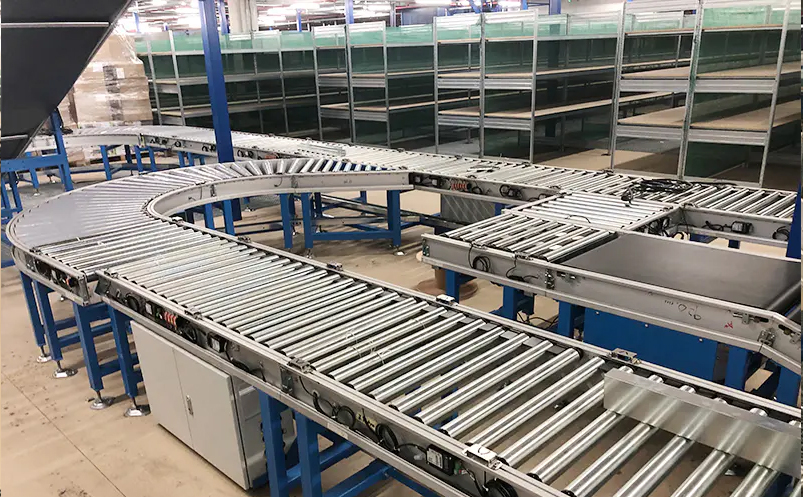
Each drive roller contains a self-contained electric motor and gear reducer housed within the roller tube. Power is fed through the shaft ends, and torque is transferred directly to the tube—no external chain, belt, or coupling required on the drive side. Neighboring idle rollers are linked via PU V-belts, sprocket chains, or O-belts, depending on the model series, so a single motorized roller can drive a complete zone of the conveyor.
This electric motor roller conveyor architecture reduces mechanical complexity, lowers noise levels, and makes zone-based accumulation straightforward to implement without additional clutch mechanisms.
AC vs DC: Which Power Type Fits Your Application?
The single most important specification decision is voltage type. Both have well-defined use cases, and choosing incorrectly costs money in either over-engineering or recurring jams.
| Parameter | AC Motor Roller | DC Motor Roller |
|---|---|---|
| Typical Voltage | 100–240 V AC | 12 V / 24 V DC |
| Torque Characteristic | Speed-dependent torque | Constant high torque at all speeds |
| Speed Adjustment | Via frequency inverter | Simple voltage control; easy fine-tuning |
| Best For | Light, flat, uniform loads | Variable loads, fragile goods, accumulation zones |
| Safety Level | Standard | Higher (low voltage, safe to touch) |
| Typical Drive Modes | Single-action, PU V-belt, #40 Sprocket | Single-action, PU V-belt, #40 Sprocket |
AC motor rollers are the standard choice for packaging lines handling boxed goods at consistent weight and shape. DC series motor rollers, running at 24 V, are preferred wherever operators interact closely with the line, loads vary significantly, or soft-start behavior is needed to protect fragile products.
Drive Mode Options and What They Mean in Practice
Beyond voltage, the drive mode determines how the motorized roller transmits motion to adjacent idle rollers. Three configurations cover most applications:
- Single-action (direct drive): The motorized roller drives only itself—ideal for wide-pitch layouts or when each zone needs independent control.
- PU V-belt drive: A polyurethane belt links the motor roller to neighboring idlers. Quiet operation, low maintenance, and good for light-to-medium loads. Used in SST-57B / DC-57B and SST-57D / DC-57D series.
- #40 Sprocket drive: A roller chain transmits power. Higher load capacity and more positive engagement—suited for heavier cartons or applications where belt slip would cause timing issues. Used in SST-57C / DC-57C series.
The SST-38D and DC-38D series use a narrower 38 mm roller diameter with PU V-belt drive, covering applications where conveyor width is minimal and load weights are light.
Where These Conveyors Are Actually Deployed
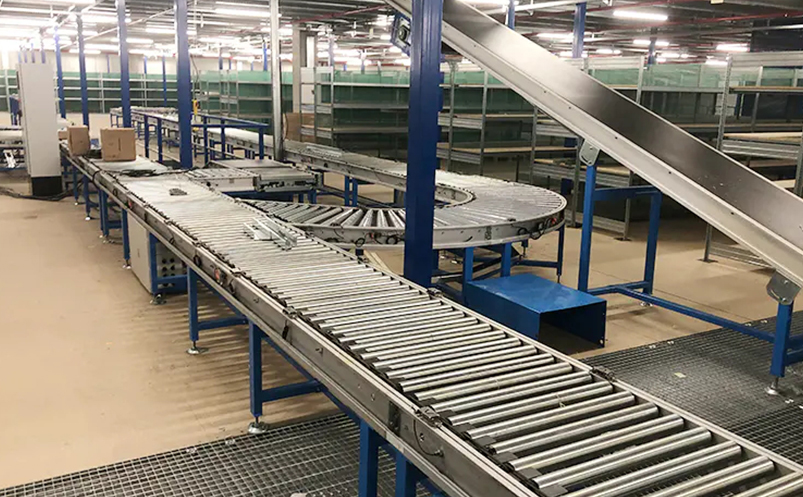
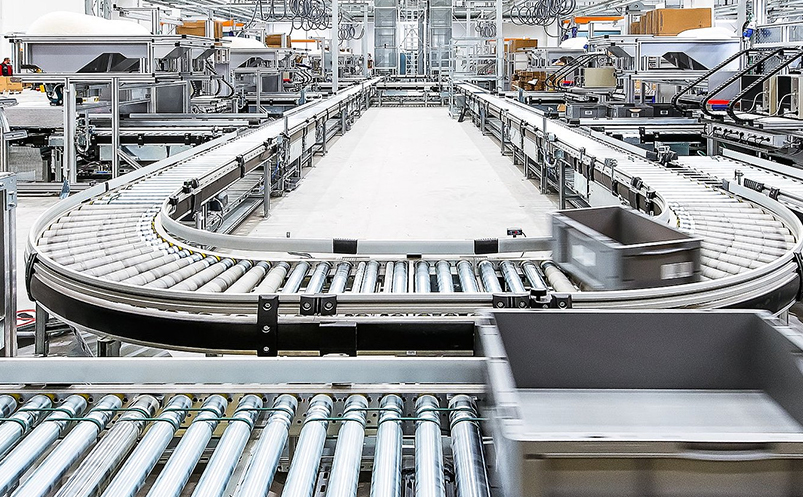
Electric motor roller conveyors dominate three environments: packaging lines, e-commerce fulfillment centers, and light assembly. In packaging, the space savings allow multiple conveyor segments to run parallel in the same footprint previously occupied by a single belt conveyor. In fulfillment, DC-powered zones enable zero-pressure accumulation roller conveyor sections where parcels queue without back-pressure damage—critical for fragile goods.
In light assembly, the ability to run zones at different speeds—or stop individual zones independently—lets operators create buffer zones between workstations without adding complex pneumatic back-pressure systems. The modular nature of motor roller conveyors makes reconfiguration fast: adding or removing a zone is a matter of extending the frame and connecting power, not redesigning the entire drive train.
Four Things to Confirm Before Ordering
- Load per roller, not just total load: A 50 kg carton spread across 5 rollers is very different from the same carton on 2. Verify the per-roller load and match it to the roller's rated capacity.
- Required conveying speed: DC rollers are easier to fine-tune; if you need variable speed across a line, DC with voltage control is more practical than AC with multiple inverters.
- Roller diameter and pitch: Smaller products need closer roller pitch. The 38 mm diameter series handles narrow frames; the 57–60 mm series handles heavier or wider goods.
- Operating environment: Packaging plants with food contact or washdown requirements should specify stainless steel components—check whether the frame and roller shell materials are compatible before the conveyor is manufactured.
Maintenance Expectations
Because motors are sealed inside the roller, there is no gearbox to top up with oil. Routine maintenance focuses on three areas: checking PU belt tension and condition every 3–6 months, inspecting bearing surfaces at the shaft ends for contamination, and confirming that electrical connectors are clean and properly seated. Most well-manufactured motor rollers will run 20,000–30,000 hours between replacements under normal duty cycles—comparable to the conveyor frame itself.
When a motor roller does fail, it is replaced as a unit in minutes rather than requiring a drive system rebuild. This modularity keeps unplanned downtime short and spare parts inventories simple.
Summary
Electric motor roller conveyors earn their place on modern production lines by combining compact installation, flexible zone control, and low ongoing maintenance into a single, well-understood package. Choosing between AC and DC comes down to load variability and operator proximity; choosing the drive mode comes down to load weight and timing requirements. Get those two decisions right, and the conveyor will run reliably for years with minimal intervention.