

 ENG
ENG 中文简体
中文简体 русский
 Français
 Español
 日本語
日本語 عربى
عربىContent
Most production lines don't run in a straight line. Columns, walls, existing equipment, and floor space constraints force layouts to turn — and every turn is a potential bottleneck. Curve roller conveyors solve this problem directly: they redirect product flow through smooth, continuous arcs without stopping the line, repositioning goods, or adding manual transfer steps.
According to the Material Handling Industry's conveyor fundamentals guide, conveyors that eliminate non-value-added travel time and manual handling steps are among the most impactful investments a facility can make. Curve roller conveyors are exactly that kind of investment.
How Curve Roller Conveyors Work
The engineering challenge in any curved conveyor is speed differential. The outer edge of a curve travels a longer path than the inner edge — if all rollers spin at the same rate, products will skew, jam, or tip.
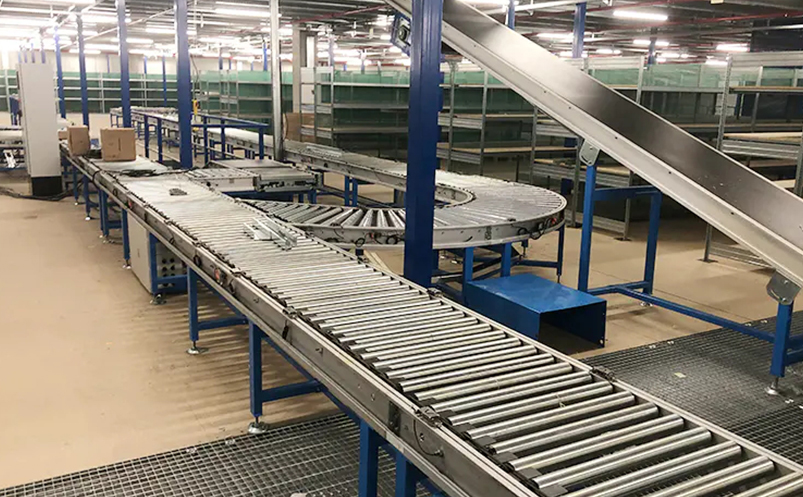
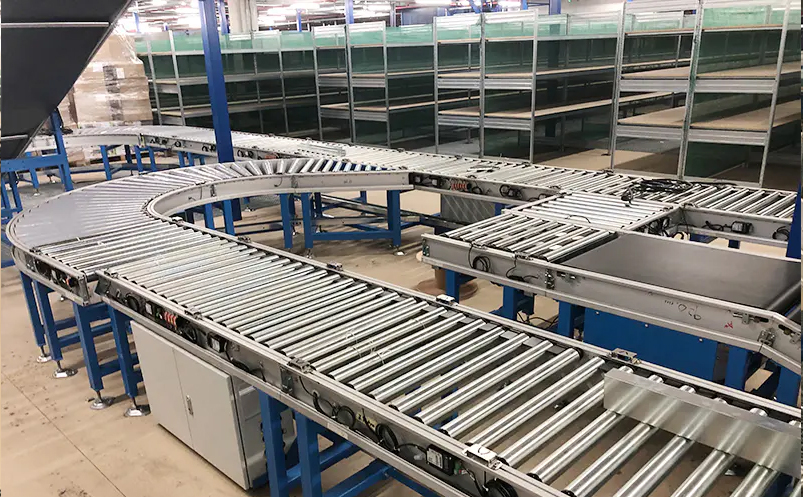
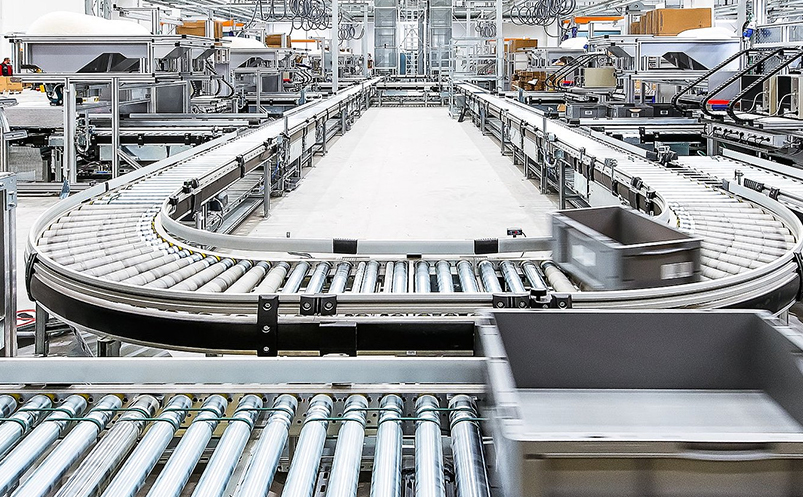
Curve roller conveyors address this with tapered rollers: each roller is wider at the outer edge and narrower at the inner edge. This conical shape automatically compensates for the difference in arc length, keeping surface speed consistent across the full width of the conveyor. Products move through the curve without drift, without stopping, and — critically — without changing their orientation. The front of a box entering the curve remains the front when it exits.
For powered systems, drive mechanisms (O-belt, V-belt, or motorized roller) are calibrated to maintain consistent throughput speed across the curve. Gravity-fed versions rely on a slight incline to keep goods moving. Both configurations use taper roller conveyors for curved section integration as their core component.
Available Angles and Configuration Options
Curve roller conveyors are available in standard arc angles of 30°, 45°, 90°, and 180°, with custom angles available for specialized layouts. The 90° curve — a right-angle turn — is the most widely deployed, fitting neatly into L-shaped floor plans. The 180° configuration allows incoming and outgoing lines to run parallel, which is highly efficient in tight spaces.
| Curve Angle | Typical Use Case | Space Impact |
|---|---|---|
| 30° / 45° | Gentle directional shifts, diagonal layouts | Low — minimal footprint change |
| 90° | Right-angle turns, L- or U-shaped lines | Medium — corner floor area required |
| 180° | Parallel return lanes, space-saving U-turns | Compact — two lines side by side |
On the drive side, gravity configurations suit low-traffic or budget-sensitive applications. Powered options — using driven roller conveyor systems — are the standard choice when throughput consistency, load control, or heavy items are involved. Zero-pressure accumulation variants are also available for lines where products must pause without collision.
Key Applications Across Industries
Curve roller conveyors are deployed wherever product flow must navigate physical constraints. The industries that rely on them most heavily include:
- E-commerce and distribution centers — high-speed parcel sorting systems use 90° and 45° roller curves to route packages across multiple sortation lanes within a compact footprint.
- Food and beverage processing — stainless steel or resin roller curve conveyors direct packaged goods through washdown environments while maintaining hygienic flow.
- Automotive manufacturing — heavy-duty curve sections handle parts and sub-assemblies along assembly lines that wrap around press equipment or between production cells.
- Airport baggage handling — curves integrate into long, winding baggage claim and check-in systems where flat-top belt curves ensure reliable orientation for irregular luggage shapes.
- Packaging lines — curved sections connect filling, labeling, and cartonizing stations that cannot be aligned in a straight run.
What to Consider When Selecting a Curve Roller Conveyor
Selecting the right curve comes down to four parameters that must be evaluated together, not in isolation.
Product dimensions and stability. The minimum item length determines roller spacing; every product must span at least three rollers at all times. Width determines the conveyor's inner and outer radius — a wider belt needs a larger inner radius to avoid excessive speed differential at the edges.
Load capacity and roller material. Steel rollers handle heavy loads and high-impact applications. Plastic or resin rollers are better suited for fragile, light, or food-grade items. For corrosive or washdown environments, stainless steel is the only reliable option.
Curve radius. A larger radius is gentler on loads and accommodates wider items, but demands more floor area. Smaller radii are compact but restrict the maximum product width and may require powered drive to prevent stalling.
Gravity vs. powered drive. Gravity curves are simpler and lower-cost, but depend on consistent incline and load weight to maintain flow. Powered curves offer precise speed control and are the right choice for heavy goods, high throughput, or horizontal layouts. Explore the full roller conveyor product range to match the curve section with compatible straight runs and drive systems.
Getting these four variables right from the start eliminates the most common problems in curve conveyor installations: product jamming at the inner rail, skewing through the bend, and speed mismatches at the transition back to straight sections.