

 ENG
 中文简体
 русский
 Français
 Español
 日本語
 عربى
Content
- 1 What a Chain Conveyor Does and When It Beats Roller Alternatives
- 2 Chain Conveyor Types and the Loads They Handle
- 3 Selection Criteria: Speed, Load, Environment, and Accumulation
- 4 Integration, Safety, and Maintenance Points That Decide Uptime
- 5 Where Chain Conveyors Fit in Warehousing and Manufacturing
- 6 Chain Conveyor FAQ
A chain conveyor is a material handling machine that moves loads on one or more endless chains, often with rollers, slats, or fixtures attached to the chain. It is the type you specify when a roller conveyor starts to slip under a 1,200 kg pallet, or when an assembly line needs repeatable indexing within a few millimetres.
The working principle is simple: a motor turns a sprocket, the sprocket drives the chain, and the chain carries the load along a guided path. That positive engagement is why chain conveyors hold up in pallet handling, stamping lines, foundries, and assembly operations where friction-driven rollers would wear out or lose position.
For buyers, the practical question is not whether chain conveyors are strong. It is whether the chain, guide rail, take-up, and transfer layout form one wear system. A chain that is oversized for the load but undersized for the environment will still fail early.
What a Chain Conveyor Does and When It Beats Roller Alternatives
A chain conveyor transfers load through the chain rather than through rollers driven by an O-band or friction wheel, which is why it holds up under heavy pallets, heat, and frequent accumulation. One or two strands usually run in wear guides. The load sits directly on the chain, on rollers mounted between chain strands, or on slats and fixtures attached to the chain.
| Criterion | Chain conveyor | Roller conveyor | Belt conveyor |
| Drive | Sprocket and chain; positive engagement | O-band, friction wheel, or motorized roller | Pulley and belt friction |
| Typical unit load | Heavy pallets and fixtures; multiple strands raise capacity | Cartons, totes, and light pallets | Bulk material or continuous small items |
| Accumulation | Stops, zones, or accumulation rollers; low back pressure possible | Good for cartons; zone control depends on roller type | Limited without special belt or gap control |
| Environment | Heat, oil, dust, washdown, and heavy-duty areas | Clean indoor areas and light assembly | Bulk handling and smooth product flow |
| Maintenance focus | Chain tension, sprocket wear, guide rails, lubrication | Roller bearings, O-bands, and drive alignment | Belt tracking, tension, and splice condition |
Chain Conveyor Types and the Loads They Handle
Most industrial chain conveyors fall into four families: roller chain conveyors, slat top chain conveyors, double speed chain conveyors, and heavy-load chain conveyors.
 Custom Chain Conveyor for Pallets and Heavy TotesCustom roller chain conveyor for pallet and large-tote handling, with BDC double-row and three-column models and stated loads from 500 to 3000 kg.View Product →
Roller chain conveyors
These use one or more roller chains running in guide rails. They are common for pallets, stillages, and heavy totes. The load can sit on the chain links, on rollers between the strands, or on a pallet pushed by chain-mounted dogs.
Slat top chain conveyors
A slat top chain conveyor uses wide plastic or stainless steel slats linked into a continuous surface. It fits beverage lines, food processing, and small parts that need a stable surface rather than two narrow chain strands.
Double speed chain conveyors
These are assembly-line conveyors. The chain runs at one speed and carries pallets or fixtures at another through a speed-up section. Workstations can stop a pallet without stopping the whole line.
Heavy-load chain conveyors
Heavy-load designs use larger pitch chain, multiple strands, reinforced guide rails, and heavier take-up frames. They appear in tire plants, steel mills, stamping lines, and areas where shock loading is normal.
Selection Criteria: Speed, Load, Environment, and Accumulation
Size a chain conveyor from four inputs: the load per unit, required throughput, chain speed, and the operating environment. Start with the heaviest unit load, not the average, then add an impact allowance for jammed pallets, mistimed transfers, and stops.
- Define the unit load. Record weight, footprint, center of gravity, and whether the load is rigid or flexible.
- Set throughput and speed. Chain speed follows from pallet pitch, cycle time, and accumulation logic.
- Choose chain and guide material. Carbon steel, stainless steel, plastic top, or special coatings each solve a different wear or corrosion problem.
- Check the environment. Temperature, washdown chemicals, oil, dust, and explosion risk change lubrication, clearances, and certification requirements.
- Lock the interfaces. Transfer gaps, stop positions, sensors, and operator access decide whether the line runs at rate or becomes a bottleneck.
 Heavy-Duty Chain-Driven Roller Conveyor for RampsHeavy-duty chain-driven roller conveyor for loads on ramps and flat sections, with KPR-SW models and external bearing supports for stability.View Product →
Integration, Safety, and Maintenance Points That Decide Uptime
Most chain conveyor downtime happens at transfer points, accumulation zones, and chain tensioning devices, not in the straight middle section. Transfers are where pallets catch dead plates, sensors miss flags, and chains run out of alignment.
Reliable integration
- Transfer gaps sized to the smallest and largest load
- Stops and sensors mounted on rigid, accessible brackets
- Guards that allow inspection without removing the chain
- Take-up travel visible on the frame
Common mistakes
- Using average pallet weight for chain selection
- Setting accumulation zones by guesswork
- Mixing chain pitches on the same drive
- Leaving lubrication to the maintenance team without a specification
Maintenance is mostly about watching three things: chain elongation, sprocket tooth wear, and guide rail wear. Check take-up travel and chain slack at the interval recommended for the duty cycle. In washdown areas, use the correct chain-driven roller conveyor lubrication and confirm that the lubricant is compatible with the chain coating and the product being handled.
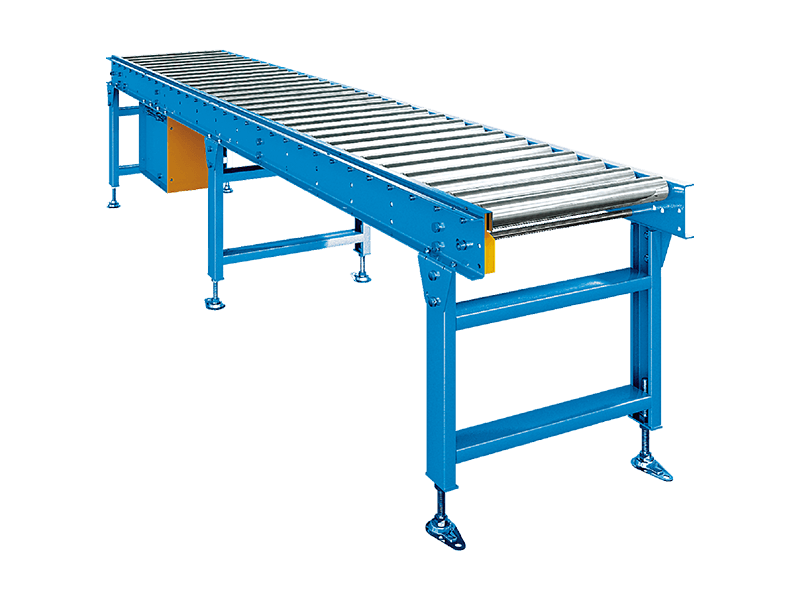 Chain-Driven Roller Conveyor Series and ModelsPowered roller conveyor category with single- and double-sprocket types, HKR and KTR series, and high-temperature configurations for hot industrial settings.View Product →
Where Chain Conveyors Fit in Warehousing and Manufacturing
Chain conveyors are the default choice for pallet handling, assembly indexing, and harsh-duty transfer zones. The same positive-drive principle works in a freezer, a foundry, a paint shop, and a distribution center, provided the chain material, lubrication, and guide rails are matched to the condition.
Pallet and tote transport
Warehouse pallet lines, staging lanes, and transport between storage and dispatch.
Assembly and indexing
Automotive, appliance, and electronics lines that need repeatable pallet stops.
Harsh and heavy duty
Stamping, tire, foundry, and washdown areas where belts and light rollers fail early.
Chain Conveyor FAQ
A chain conveyor is usually the right choice when the load is heavy, the duty is harsh, or the line needs positive indexing. These are the questions that most often decide the specification.
What is the difference between a chain conveyor and a roller conveyor?
A roller conveyor usually moves loads on free or driven rollers; a chain conveyor uses one or more endless chains to pull or carry the load. Chain conveyors provide positive drive and higher load capacity, while roller conveyors are often simpler for light cartons and totes.
How much load can a chain conveyor handle?
It depends on chain size, strand count, support spacing, and speed. Standard industrial chain conveyors handle pallets from a few hundred kilograms to several tonnes; heavy-load designs use multiple strands and reinforced guide rails. Always size from the heaviest unit load, not the average.
When should I use a chain conveyor instead of a belt conveyor?
Use chain when the load is heavy, hot, oily, or needs accumulation with low back pressure. Use belt for bulk materials or where a continuous smooth surface is required. Chain conveyors also handle pallets and fixtures that would damage a belt.
What maintenance does a chain conveyor need?
Inspect chain tension, sprocket wear, guide rails, and lubrication at fixed intervals. Check for elongation, loose pins, and worn wear strips. In washdown or high-temperature environments, use the lubricant and chain material specified for that condition.