

 ENG
ENG 中文简体
中文简体 русский
 Français
 Español
 日本語
日本語 عربى
عربىContent
What Makes Accumulation Conveyors Different
A standard conveyor moves everything at the same speed — which sounds efficient until one station slows down and the entire line backs up. Accumulation conveyors solve this by letting products queue up in controlled zones, holding items in place without stopping upstream operations. The line keeps running; only the buffer fills and empties as needed.
This decoupling of upstream and downstream speeds is what separates accumulation systems from conventional conveyors. Think of it like a traffic light for your production line — products stop, wait, and release on cue, instead of colliding into a jam.
Three Types of Accumulation: Choose Based on Your Product
Not all queuing is the same. The right accumulation mode depends on how sensitive your products are to contact and pressure.
Zero-pressure accumulation (ZPA) uses photoelectric sensors to divide the conveyor into independent zones. Each zone stops before the next fills, so products never touch. This is the standard choice for fragile items — electronics, glass containers, premium packaging — where even light contact causes damage.
Minimum-pressure accumulation allows products to make light contact during queuing, maintained by a constant low drive force. It costs less and works well for robust, uniform products in short accumulation sections — for example, cartons queuing before a packing station.
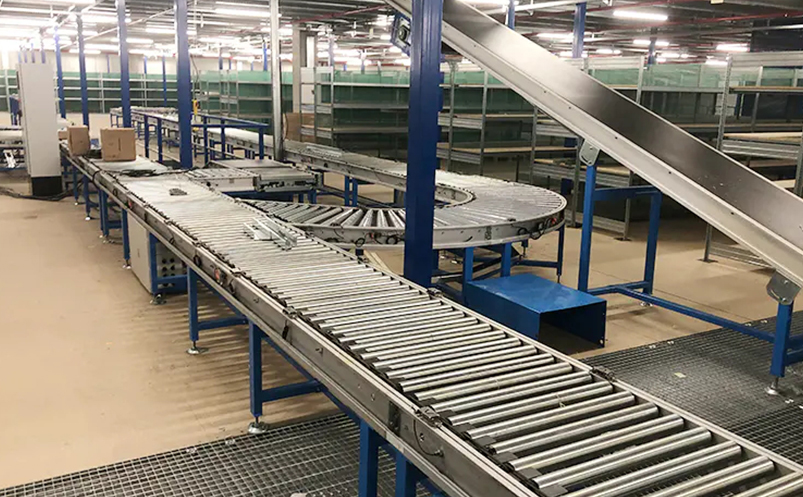
Zero-contact accumulation goes a step further than ZPA: each zone actively holds its spacing gap, ensuring products never come close to touching. It is the preferred option for the most delicate or irregularly shaped goods. Our accumulating roller conveyor range covers all three modes and can be configured to match your exact product profile.
The Real Impact on Throughput
Line balancing — matching the speed of each workstation to the others — is one of the hardest problems in production design. Accumulation conveyors sidestep it. By creating buffer zones between stations, fast processes no longer idle while slow ones catch up, and slow stations are never overwhelmed by upstream output.
The measurable outcome: facilities that integrate accumulation systems typically see 30–40% higher throughput and handling time reductions of up to 50%, depending on configuration. More predictable flow also means fewer manual interventions and a reduced risk of line stoppages cascading across stations.
For operations running at high volume — distribution centers, e-commerce fulfillment hubs, automotive assembly lines — these gains compound quickly. An hour of line time recovered per shift can represent significant output at scale.
Drive Technologies: Matching the System to the Load
Accumulation conveyors come in several drive configurations. The right choice depends on load weight, required speed, and available space.
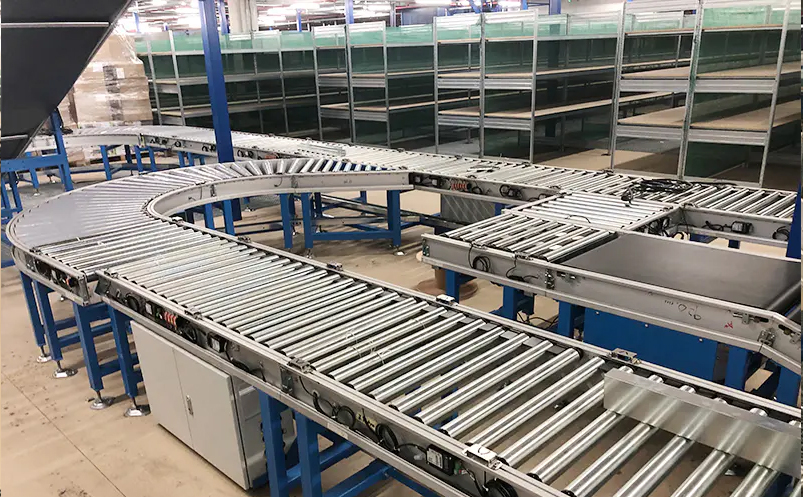
Motor-driven roller (MDR) systems embed a motor inside individual rollers, with O-bands transferring drive to adjacent rollers within each zone. They run quietly, consume energy only when product is present, and require minimal maintenance — making them a strong default for light-to-medium carton and tote handling. Our electric motor roller conveyors are engineered for this kind of zone-controlled, on-demand operation.
Chain-driven live roller (CDLR) systems connect rollers with chains and sprockets, providing positive drive suitable for heavy pallets and dense unit loads. They handle demanding environments where lighter drive mechanisms would slip or wear prematurely. See our chain-driving roller conveyor for high-load applications.
Belt-under-roller designs use a continuously running flat belt that can be raised or lowered to engage rollers, allowing pneumatic or mechanical zone control. They are widely used in distribution centers handling mixed carton sizes.
For facilities where floor space is constrained, spiral accumulation — moving product vertically through a helical path — creates buffer capacity without expanding the footprint. It is particularly useful in packaging and processing lines where products need time between stages.
Where Accumulation Conveyors Are Used
The applications are broad, but the underlying logic is the same: anywhere two processes run at different speeds, a buffer is needed between them.
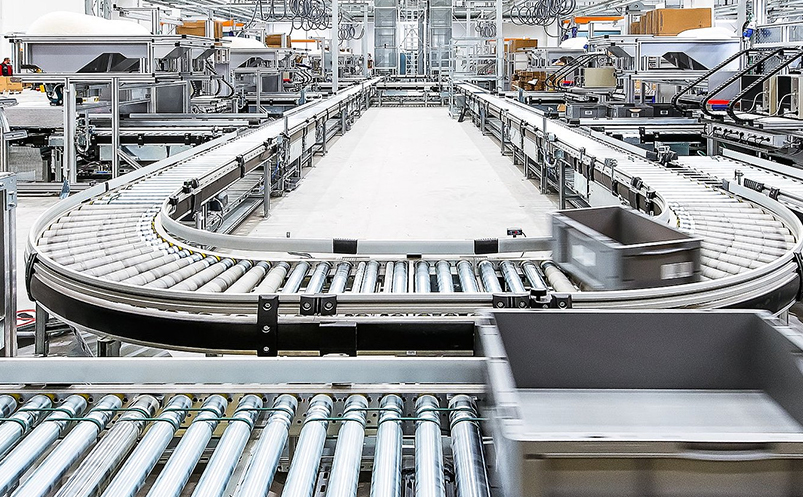
In distribution and fulfillment centers, accumulation systems sit before and after sorters, feeding merge points and shipping docks. They absorb the burst output of a high-speed sorter and deliver product to loading staff at a manageable pace. In manufacturing, they decouple assembly stations — allowing one station to be serviced without halting an entire line. In food and beverage, they provide dwell time for cooling, drying, or inspection between filling and packaging. Our accumulating rollers are specifically designed for these buffer-zone demands across industries.
As automation deepens, accumulation conveyors are also being integrated with AMRs (autonomous mobile robots), allowing robotic infeed and outfeed at conveyor endpoints — extending the reach of automated material flow without requiring fixed infrastructure throughout a facility.
Choosing the Right System
Before specifying an accumulation conveyor, four factors matter most: the size and weight range of your products, the expected accumulation density (how full the buffer typically runs), the release mode required (singulation versus slug release), and whether your environment places any temperature, hygiene, or load constraints on materials.
Singulation release — one product at a time — gives the most precise downstream spacing and is standard for sortation feeds. Slug release — an entire queued group released simultaneously — delivers higher burst throughput and suits scenarios where downstream equipment can accept product in batches, such as palletizing stations.
Getting these parameters right at the design stage determines whether accumulation adds genuine capacity or simply relocates a bottleneck. Working through product profiles and space constraints with a conveyor specialist before finalising a layout avoids the most common sizing errors.