

 ENG
 中文简体
 русский
 Français
 Español
 日本語
 عربى
Content
Most plants order a standard type belt conveyor for the same reason: it is the cheapest reliable way to move a carton, a machined part or a sack of raw material between two fixed points. The frame is pre-engineered, the belt width comes off a short catalogue list, and the drive is a stock geared motor or drum motor. Whether that unit runs quietly for a decade or starts tracking to one side within a month is decided by details the catalogue rarely prints: pulley crowning, take-up travel, transfer gaps and the load profile at the tail end.
A standard type belt conveyor is a fixed-frame machine in which an endless flat belt runs over a head pulley, a tail pulley and a set of carrying idlers, driven at fixed or variable speed by a geared motor or a drum motor. Standard here means pre-engineered frame profiles, catalogue belt widths and repeatable modules rather than a bespoke design.
What a Standard Type Belt Conveyor Actually Is
Strip away the paint and almost every standard unit contains the same eight components, whatever the badge on the frame.
- Frame: bolted or welded channel steel, or an extruded aluminium profile, supplied painted, galvanised or in stainless steel.
- Head pulley: normally crowned, sometimes lagged, and it sets the release point where product leaves the belt.
- Tail pulley: frequently combined with a screw take-up so belt tension can be set during commissioning.
- Carrying idlers: flat rollers at 400 to 600 mm pitch on light and medium duty units.
- Return rollers: spaced wider than the carrying idlers and the first parts to seize when greasing is neglected.
- Belt: PVC or PU for general and food duty, EP rubber for abrasive bulk material.
- Drive: a geared motor with chain and sprocket transmission, or a drum motor built into the head pulley.
- Guides, guards and a local control box with emergency stop.
The commercial value of a standard frame is interchangeability. Motors, idlers, pulleys and belt splices follow catalogue sizes, so a replacement part is usually a stock item rather than a four-week fabrication job, and a second identical unit can be ordered later without redrawing the line.
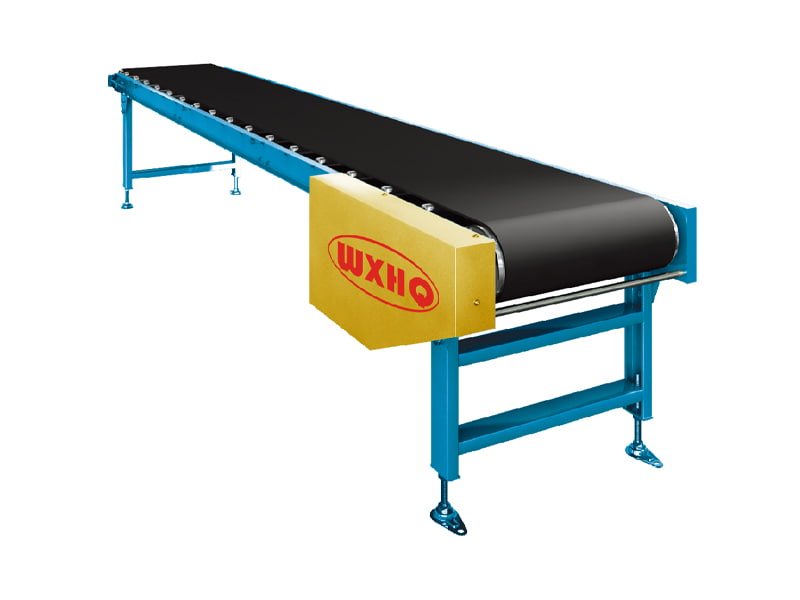 Standard Type Belt Conveyors for Lightweight Material HandlingLightweight standard belt conveyors with interchangeable frames, multiple belt materials and model sizes for items under 100 kg or bulk materials.View Product →
Frame, Belt and Load Ranges That Set the Layout
The frame and belt decide the maximum load, speed and incline long before the motor does; fix them first and drive sizing becomes arithmetic rather than guesswork.
| Parameter | Typical standard range | What it changes |
| Belt width | 300 to 1000 mm | Throughput per hour and how stably a product sits on the belt |
| Frame section | 40x40 or 60x60 profile, 100x50 channel | Support span and deflection under full load |
| Belt grade | PVC two-ply, PU, EP rubber three-ply | Grip, oil resistance, food contact, abrasion life |
| Speed | 0.1 to 1.0 m/s, fixed or inverter driven | Transfer impact, noise and whether products can queue |
| Distributed load | 30 to 100 kg/m on standard frames | Idler pitch, motor rating, leg spacing |
| Incline | Up to 15 degrees with a smooth belt | Footprint, transfer height, need for cleats |
| Idler pitch | 400 to 600 mm carrying | Belt sag between rollers and running power |
| Take-up | Screw on short centres, gravity on long runs | How much belt stretch the unit can absorb |
Deflection, not material strength, is usually the real constraint. A 60x60 profile that looks generous on paper sags once a 100 kg/m load sits between supports three metres apart. Adding one support leg is normally cheaper and stiffer than moving to a heavier section.
Drive, Take-Up and Control Choices
Under roughly 20 m of centre distance and 50 kg/m of load, a drum motor is usually the tidiest drive; longer or heavier runs normally justify a geared motor with chain transmission and a gravity take-up.
Drum motor or geared motor
A drum motor hides the gearing inside the head pulley. There is no exposed chain, no separate guard to clean around, and washdown areas stay simple. The trade-offs are real: a failure means removing the pulley, and motor heat sits inside the belt loop, which matters on temperature-sensitive products. A geared motor with chain drive is easier to repair in place and cheaper in heavy duty sizes, but it needs guarding, lubrication and periodic chain tension checks.
Screw take-up or gravity take-up
Screw take-up suits short centres where belt stretch is small and occasional manual adjustment is acceptable. Gravity take-up holds tension automatically and is the better choice once centre distance passes about 20 m or the load varies through the shift. Allow 1.5 to 2 percent of centre distance as usable take-up travel, and show that travel on the general arrangement drawing.
Soft start matters more than top speed. A three to five second ramp on an inverter prevents product tipping at the transfer point and reduces belt slip on start-up, which is the most common cause of glazed belt surfaces on short, heavily loaded units.
 Oil-Cooled Mini Drum Motors for Belt ConveyorsOil-cooled mini drum motors for belt conveyor drives, offered in multiple diameters and AC/DC configurations for customizable conveyor layouts.View Product →
Where a Standard Frame Fits and Where It Stops Fitting
A standard type belt conveyor is the right answer for straight, single-level transport of regular, stable products; it becomes the wrong answer as soon as the product has to turn, accumulate under pressure or climb above roughly 15 degrees.
Fits well
- Cartons, totes and machined parts between fixed stations
- Assembly line feed with a steady takt time
- Food areas running a PU belt on a stainless frame
- Inclines under 15 degrees with a smooth belt
- Long straight runs with gravity take-up
Needs another type
- Curves and 90 degree transfers
- Zero-pressure accumulation, where accumulating rollers or a full sorting and conveying system does the job better
- Fragile or irregular items that need pockets or nesting
- Inclines above 20 degrees without cleats or flights
- Hot, oily or explosive atmospheres without a specification change
If the layout needs more than two transfers or any change of direction, the standard frame has stopped being the cheap option.
Handing product over to an existing control system is where most projects lose time. If the line has to talk to a PLC, a vision station or a robot cell, these notes on how a standard type belt conveyor is integrated with existing automation systems cover the handshake, guarding and sensor details.
A Six-Step Selection Checklist
Work through these six points in order and most sizing arguments disappear before the quotation stage.
- Product data: weight per item, footprint, centre of gravity, surface temperature, and any oil or water contact.
- Throughput maths: items per minute multiplied by pitch gives belt speed; add a 20 percent margin for surge.
- Layout: centre distance, incline, transfer heights and operator access on both sides.
- Drive and control: fixed or variable speed, soft start, photo-eyes and emergency stop zoning.
- Environment: washdown, dust, ambient temperature and whether explosion protection is required.
- Spares and documentation: belt, idlers, splice kit, wiring diagram and the belt tension figure.
Ask for the take-up travel and the belt length on the drawing. If either is missing, installation day will find it for you, usually with the line already bolted down.
Failure Modes and Service Intervals
Most problems on a standard frame come down to tracking, tension or idler condition, and all three give warning well before a stoppage.
| Symptom | Usual cause | First check |
| Belt runs to one side | Frame out of square, pulley not level, off-centre loading | Measure frame diagonals, then pulley level |
| Belt slips at the head | Tension lost, lagging worn, overloaded | Take-up travel used, then load profile |
| Belt surface glazed | Repeated slip on the drive pulley | Clean the pulley, increase wrap or lagging |
| Edge wear on one side | Misalignment or over-tension | Re-track before ordering a new belt |
| Rumbling or squealing | Seized idler bearing or flat spot | Hand-spin every idler on a monthly walk-round |
| Splice lifting | Wrong splice angle, moisture ingress | Inspect the splice at three-month intervals |
Intervals that hold up in practice: a visual walk-round weekly, idler hand-spin monthly, tension and tracking check quarterly, gearbox oil change on the maker's hours, and a splice inspection every three months. Replacing carrying rollers on schedule is far cheaper than replacing the belt they damaged.
 Carrier Rollers for Trough-Type Belt ConveyorsCarrier and return roller series for trough-type belt conveyors, including impact, spiral and two-trough return variants for bulk material support.View Product →
Frequently Asked Questions
What is the difference between a standard type belt conveyor and a custom conveyor?
A standard unit uses catalogue frame profiles, belt widths and drive sizes, so it is priced from a list and delivered in weeks. A custom conveyor is designed around a specific product, incline or hygiene rule, which adds engineering time and cost but is unavoidable when the layout includes curves, tight transfers or unusual loads.
What belt widths and loads can a standard unit handle?
Catalogue widths typically run from 300 to 1000 mm with distributed loads of 30 to 100 kg/m on a standard frame. Anything wider or heavier is normally built as a modular frame with engineered support spacing rather than shipped as a stock unit.
Can a standard belt conveyor run on an incline?
Yes, up to about 15 degrees with a smooth belt and regular, stable products. Beyond that, cleats, flights or a different conveyor type are needed, because flat products start to slide back and round items roll even on a modest slope.
How long does the belt itself last?
On single-shift duty, PVC and PU belts commonly run three to five years and rubber belts longer, but tracking quality and edge damage decide the outcome far more than abrasion. A belt that is correctly tracked and not over-tensioned usually outlives its splice.