

 ENG
ENG 中文简体
中文简体 русский
 Français
 Español
 日本語
日本語 عربى
عربىContent
- 1 What a Roller Conveyor Actually Does
- 2 Gravity, Powered and Motor-Driven: Choosing the Drive
- 3 Types of Roller Conveyors and Where Each Fits
- 4 Load Capacity, Roller Pitch and the Sizing Mistake
- 5 Roller Materials and Working Environment
- 6 Accumulation, Sortation and Integration
- 7 Specification and Procurement Checklist
- 8 Frequently Asked Questions About Roller Conveyors
A pallet that stops dead in the middle of a forty-meter line rarely stops because it is too heavy. It stops because of a decision made months earlier: a roller pitch that leaves only two rollers under the load, a frame never rated for a full lane of product, or a drive chosen for running speed instead of starting torque.
Roller conveyors sit at the least glamorous end of material handling, and they are also among the easiest systems to get wrong, because almost every failure traces back to numbers that were available before the purchase order was signed. Those numbers are simple, and they repeat across every industry that moves rigid loads.
A roller conveyor quotation should be traceable to three figures: load per roller, roller pitch, and the frame's rated uniform load. If any of the three is missing, the quotation is a guess.
What a Roller Conveyor Actually Does
A roller conveyor moves a load across a series of evenly spaced rotating cylinders rather than on a continuous moving belt.
Definition: a roller conveyor is a frame-mounted row of cylindrical rollers set at a fixed pitch. The load rests on the roller surfaces and travels when the rollers turn, either by gravity on a declined frame or by power delivered through a chain, an O-belt, a line shaft or a motorised roller.
That single difference drives every specification decision that follows. A belt supports the whole underside of the load, so it can carry soft bags, loose parts and irregular shapes. A roller bed supports nothing at all between rollers, so the load has to carry itself. In practice that means a flat and reasonably rigid base, a footprint long enough to span several rollers, and a weight distribution that does not tip when the load accelerates or stops.
Loads that work on rollers
- Pallets, slip sheets and any unit load with a flat, stiff bottom face
- Rigid totes, crates and cartons that keep their shape under load
- Steel trays, welding fixtures and machined parts presented on a base plate
- Drums and cylinders carried on their side over a close roller pitch
Loads that work better elsewhere
- Woven sacks, soft poly bags and anything that sags between contact points
- Small loose components narrower than the roller pitch
- Items with an uneven, damaged or flexible base that will not sit flat
- Top-heavy loads that need side guidance rather than a roller bed
Gravity, Powered and Motor-Driven: Choosing the Drive
Gravity suits short declines where no accumulation is needed. Power suits level or inclined runs, controlled speed, and zones that must start and stop independently of each other.
The choice is rarely about preference. It comes down to whether the load can move on its own, whether the line has to hold product while something downstream catches up, and how much maintenance access the site can realistically provide.
Chain, line-shaft and O-belt drive
- One motor drives many rollers at once
- Lowest cost per meter on long straight runs
- Single speed unless a variable frequency drive is added
- Chain tension and lubrication are routine tasks
Motor-driven roller
- Each roller or zone carries its own motor
- Zones start and stop independently
- No chains or line shafts to lubricate
- Higher cost per meter, far simpler layout changes
| Drive arrangement | Typical application | Speed control | Main maintenance focus |
| Gravity, no drive | Order picking, packing benches, short transfers | Slope only | Roller contamination, free-running bearings |
| Chain-driven roller | Heavy pallets, inclines, long straight runs | Single speed or one shared inverter | Chain tension and lubrication |
| O-belt driven roller | Light and medium cartons, accumulation zones | Zone on or off | Belt stretch and pulley alignment |
| Motor-driven roller | Parcels, totes, sortation infeed lines | Zone-level and highly flexible | Zone controller settings and roller connectors |
Rule of thumb: a gravity lane needs enough decline to overcome bearing friction under the lightest load it will ever carry, not the heaviest. If a gravity line stalls, adding slope usually hides the real problem, which is normally roller pitch or bearing quality.
Where zones have to be added, removed or re-sequenced after commissioning, a motor-driven roller conveyor removes the mechanical link between neighbouring zones, so a layout change becomes an electrical and control task instead of a chain-routing exercise.
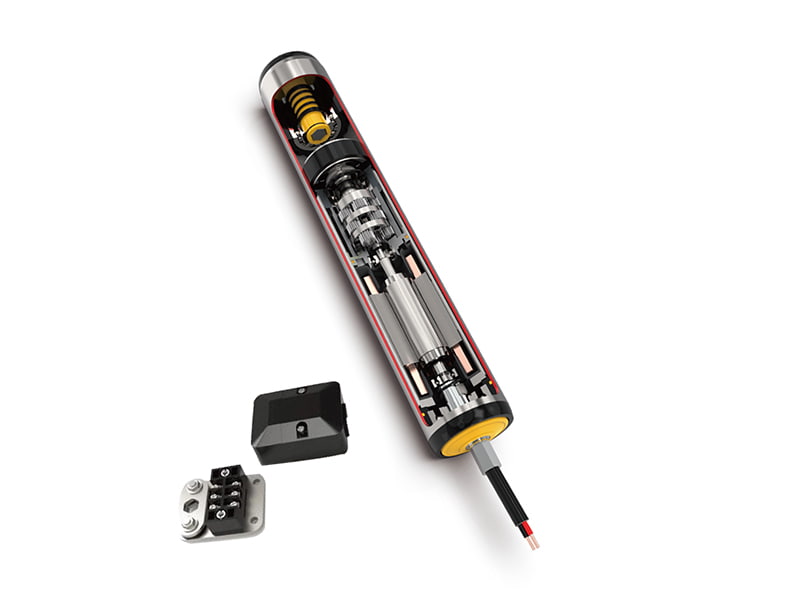 Motor Roller Conveyor Systems for Space-Saving Material HandlingElectric-roller conveyor category for multi-level or ultra-low-height layouts, with AC and DC motor roller options for flexible zone changes.View Product →
Types of Roller Conveyors and Where Each Fits
Roller conveyors are named by three things at once: the roller, the drive and the frame. A working line usually mixes several types, and the mix is decided by where the load has to turn, stop, slow down or change direction.
- Gravity roller conveyor. No drive at all. Used at packing benches, picking lanes and short transfers where the load is pushed by hand or rolls down a shallow decline.
- Chain-driven roller conveyor. A single motor drives a line of rollers through sprockets and chain. The standard answer for heavy pallets, inclines and long straight runs.
- Accumulating roller conveyor. Divides the line into zones so products wait without touching each other. Common in e-commerce fulfilment and assembly feeding.
- O-belt driven roller conveyor. Light and medium cartons, low noise, and zone control that can be reconfigured without rewiring the whole line.
- Tapered roller conveyor. Used on curves, where outer rollers must run faster than inner ones to stop the load skewing into the guard rail.
- Wheel conveyor. A close relative for lightweight, irregular or flexible loads that need to turn easily under manual handling.
Mixing conveyor types on one line is normal. Mixing load capacities is not. A gravity section feeding a powered section still has to be rated for the same peak load per roller, because a jam at the transfer point concentrates weight on a handful of rollers.
Selection is usually a process of elimination rather than optimisation: start from the load, remove every type that cannot carry it, then narrow the survivors by environment, throughput and maintenance access. A broader survey of roller conveyor types, applications and buying tips is worth reading before a specification meeting.
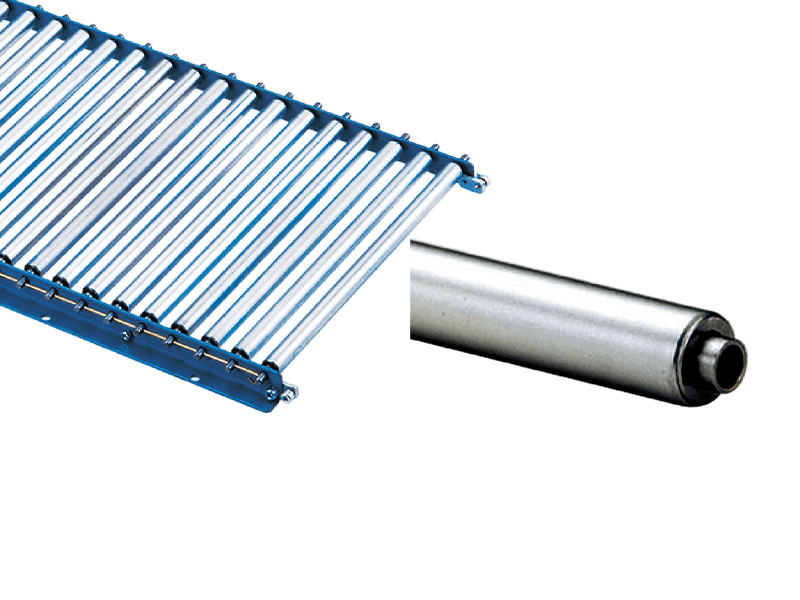 Roller Conveyor Categories for Logistics and Material HandlingCompare steel, stainless steel, resin, aluminium, taper and upwelling roller conveyor types for flat-bottom items in warehousing and logistics.View Product →
Load Capacity, Roller Pitch and the Sizing Mistake
Per-roller dynamic capacity and per-section frame capacity are two different numbers, and quoting only the first is the most common sizing error on roller conveyor projects.
A roller's capacity comes from its diameter, wall thickness, bearing type and how the shaft is retained in the frame. A frame's capacity comes from the side rail profile, the support spacing and how evenly the load is distributed across the bed. A line built from 89 mm rollers rated at 250 kg each will still sag if its side rails are supported every three meters.
Typical dynamic capacity per steel roller with general-purpose bearings. Confirm the exact figure with the supplier for the specific roller, bearing and shaft combination.
Roller pitch causes more damage claims than roller size. The working rule is that a load must always rest on at least three rollers, and four where the base is uneven, where the load is accelerated, or where it crosses a transfer. At a 100 mm pitch, a 300 mm carton sits on three rollers at best. Move the pitch to 75 mm and the same carton sits on four, which is often enough to remove the wobble operators blame on the drive.
Width follows the same logic. The frame should be wide enough that the load does not overhang the end rollers, but not so wide that products drift sideways or that operators have to reach across moving parts to correct them.
Three rollers under the shortest load is the floor, not the target. Products that are unstable, top-heavy or transferred at an angle nearly always behave better with four.
Roller Materials and Working Environment
Roller material follows the environment and the product surface, not the budget: steel for general loads, stainless steel for washdown and corrosive atmospheres, aluminium for light loads and low inertia, resin for surfaces that must not be marked.
Steel
- Highest capacity for a given diameter
- Suits dry general conveying and heavy pallets
- Painted or galvanised finishes for humid areas
Stainless steel
- Food, pharmaceutical and coastal installations
- Survives caustic washdown and frequent cleaning
- Needs food-grade lubricant and sealed bearings
Aluminium and resin
- Light cartons, totes and delicate surfaces
- Lower inertia for fast start-stop cycles
- Resin rollers protect painted or polished products
Bearings and seals matter as much as the roller body. A sealed bearing in a washdown area lasts longer than a shielded bearing of the same size, and a lubricant that suits ambient dust will fail quickly in a freezer or a drying oven.
In fine dust, solvent vapour or powder-handling areas, the question stops being about materials and becomes a safety question. The roller, the bearing seal and the drive all need to be suitable for the classified zone, and the equipment should arrive with certification that can be produced on request.
Accumulation, Sortation and Integration
Accumulation lets a roller conveyor hold product in defined zones instead of pushing it forward, and that single function is what allows a roller line to buffer, sequence and sort.
Define the zones
Zone length should be set by the shortest product and the longest, not by the drawing grid. A zone has to hold one item with clear space at both ends.
Sense the product
Photo-eyes, proximity sensors or mechanical flags at each zone boundary detect presence and confirm that a release actually happened.
Control the release
Controllers release one zone at a time downstream. The target is zero contact between products, not maximum throughput on a single zone.
Discharge or sort
A powered transfer, a pop-up wheel sorter or a pusher removes the item from the main line and hands it to the next process.
Accumulation is a control problem dressed as a mechanical problem. Most jams on an accumulation line come from zone lengths that were set from a drawing instead of from the real product mix.
Integration is where roller lines fail on site rather than in design. Transfer heights, control signals, emergency stop zones and the interface to an existing warehouse system all need to be agreed before the first frame section is bolted down, because retrofitting them later usually means cutting and re-welding supports.
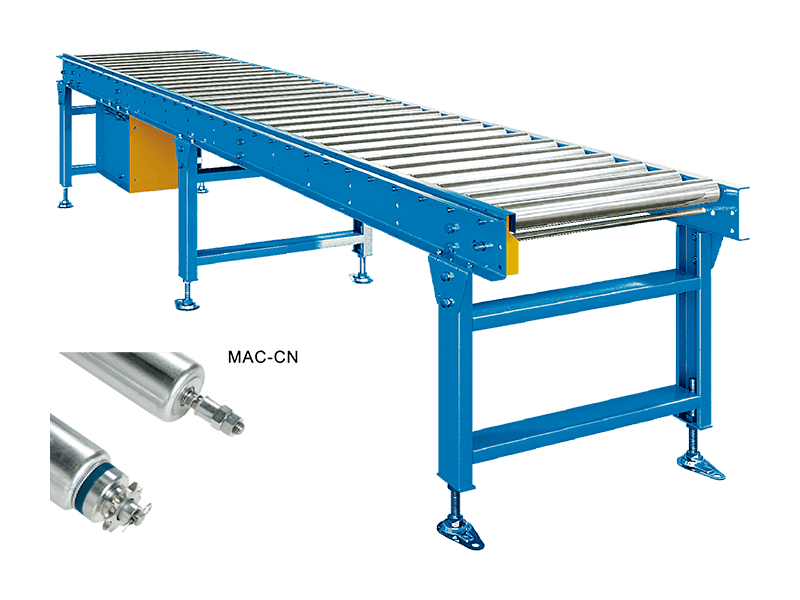 Custom Accumulating Roller Conveyors for Controlled Product FlowCustom single-row, double-row and general accumulating roller conveyor options temporarily store goods, adjust spacing, and support curved or zoned product flow.View Product →
Specification and Procurement Checklist
A roller conveyor order should be checked against the same set of figures every time, and a supplier should be able to quote each one back before the frame is cut.
- Load per roller and total load per section, stated as two separate figures.
- Roller diameter, wall thickness and bearing type, with the sealing method named.
- Roller pitch, checked against both the shortest and the heaviest product.
- Frame width, side rail profile and support spacing along the run.
- Drive arrangement, speed range and the starting torque the load actually requires.
- Environment: washdown, dust, ambient temperature and corrosive exposure.
- Interface points with existing equipment, including transfer heights and control signals.
Ask for the calculation, not just the number. A supplier who can show how the load per roller was derived is usually the one who also gets the pitch right.
Buyers who prefer to source the roller, the drive and the frame from a single production line often start by checking whether the manufacturer makes its own rollers. That reduces the number of parties involved when something does not fit on site, and it makes spare parts straightforward later. The manufacturing and certification background behind that product range is documented in Wuxi Huiqian's company profile for buyers who want to review it before the technical clarification stage.
Frequently Asked Questions About Roller Conveyors
How many rollers should support a load at one time?
At least three, and four for unstable, heavy or uneven loads. Three is the minimum that keeps a load stable when it is pushed or brought to a stop. Two rollers turn the load into a see-saw.
What is the difference between a roller conveyor and a belt conveyor?
A belt carries the entire underside of the load on a continuous surface and can handle soft or irregular items. A roller conveyor supports the load only along the roller contact lines, so it needs a flat, rigid base, but it is easier to accumulate, divert and repair section by section.
Do roller conveyors work for small or soft items?
Not without modification. Items narrower than the roller pitch or softer than the roller spacing will fall through or drag. Those loads usually move better on a belt conveyor, a wheel conveyor, or a roller conveyor with a much closer pitch and a solid base plate underneath.
How much decline does a gravity roller conveyor need?
Enough to overcome friction under the lightest load the lane will ever carry, which is typically a few degrees. The exact figure depends on bearing type, roller cleanliness and load weight, so it should be checked against the lightest item, not the heaviest.
The fastest way to reduce roller conveyor downtime is to specify load, pitch and frame support together, then check all three again against the real product mix after the first month of running.