

 ENG
ENG 中文简体
中文简体 русский
 Français
 Español
 日本語
日本語 عربى
عربىContent
A 600 mm wide flat belt conveyor moving 25 kg cartons at 30 m/min looks like a simple machine on paper. On the floor, three details decide whether it runs for a decade or needs re-tensioning every six weeks: how the pulleys are crowned, where the drive is mounted, and how the belt is spliced.
Flat belt conveyors are the default choice for horizontal transport of discrete items because the carrying surface is continuous, gentle and easy to clean. That does not make them simple to specify. Belt material, frame width, drive placement, take-up travel and the transfer at each end all have to be settled before the first frame section is welded.
What Is a Flat Belt Conveyor?
A flat belt conveyor is a continuous loop of flat belting running over a head pulley and a tail pulley, supported between them by a slider bed or a set of carrying rollers, with the top run carrying items from one point to another.
Because the surface is smooth, the design assumes each item sits stably on its own base: cartons, totes, trays, bagged goods and parts held in fixtures. Six assemblies make up almost every unit.
Belt Materials and Surface Options
Belt selection is driven by the product, the operating environment and the cleaning regime, and it should be settled before frame dimensions are fixed.
| Belt material | Best suited to | Typical working temperature | Watch out for |
| PVC | Cartons, totes, light assembly | -10 to +70 degrees C | Stiffens in cold rooms; moderate oil resistance |
| PU | Food contact, oily parts, washdown | -20 to +80 degrees C | Higher cost; needs the correct pulley diameter |
| Rubber | Heavy or abrasive parts | -20 to +60 degrees C | Heavier belt demands more drive torque |
| Silicone | Hot parts, ovens, heat tunnels | -40 to +200 degrees C | Low tear strength; poor abrasion resistance |
| Polyester fabric | High-speed light items, low noise | -10 to +100 degrees C | Sensitive to moisture and edge fraying |
Flat Belt or Cleated Belt?
Use a flat belt when items are stable, self-supporting and need a gentle surface; use a cleated belt when the load has to be held on a steep incline or indexed at a fixed pitch.
Flat belt fits when
- Items have a flat, stable base
- The product must not be marked or scratched
- Cleaning and washdown matter
- Transfers at both ends need small gaps
- Line speeds are high
- The incline stays under roughly 15 to 20 degrees
Cleated belt fits when
- The belt angle exceeds about 20 degrees
- Loose or round items would roll back
- Items must be spaced at a fixed pitch
- Granular or small parts must be contained
- Height is limited and a steep incline is the only option
Drives, Tensioning and Belt Tracking
Belt tracking, not motor size, is the most frequent cause of unplanned downtime on flat belt conveyors.
Where to mount the drive
Head-end drives pull the loaded belt and keep the top run tight. Centre drives suit long conveyors where belt stretch would otherwise cause slip. Tail-end drives are rare and usually chosen only for space reasons, because they push the belt and can buckle it during heavy starts.
Drum motor or external geared motor
A drum motor places the gearbox and the motor inside the head pulley: no exposed chain, no guard, less floor space, and sealing that suits washdown areas. An external geared motor is easier to service in place and often costs less on very long, high-torque lines.
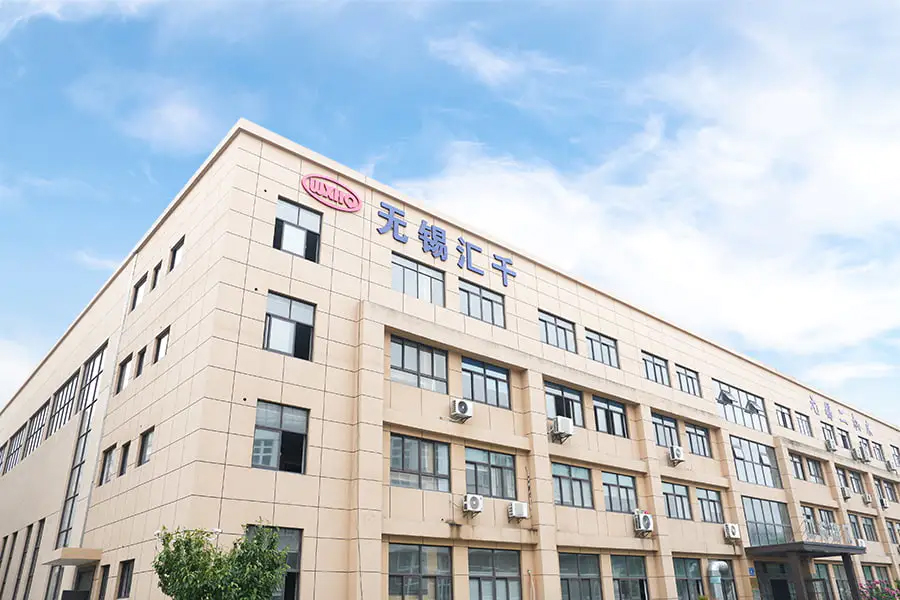 Drum Motors for Belt Conveyors SuppliersEfficient and reliable belt conveyor systems rely heavily on the performance of drum motors. Wuxi Huiqian Logistics Machinery Manufacturing Co., Ltd., a leading Chines...View Product →
Tension and take-up
Screw take-up of 30 mm to 60 mm covers normal belt stretch. Over-tensioning flattens bearings and pulls splices apart; under-tensioning lets the belt slip on the pulley and drift sideways.
Frame Layouts and Where Flat Belts Fit
Flat belt conveyors are built in three basic layouts: straight horizontal runs, inclined runs, and turning runs that redirect product flow inside a tight footprint.
Straight runs
Most flat belt conveyors are straight, assembled from modular sections of roughly 500 mm up to 12 m or more. Long runs need either a centre drive or a take-up that can absorb more belt stretch.
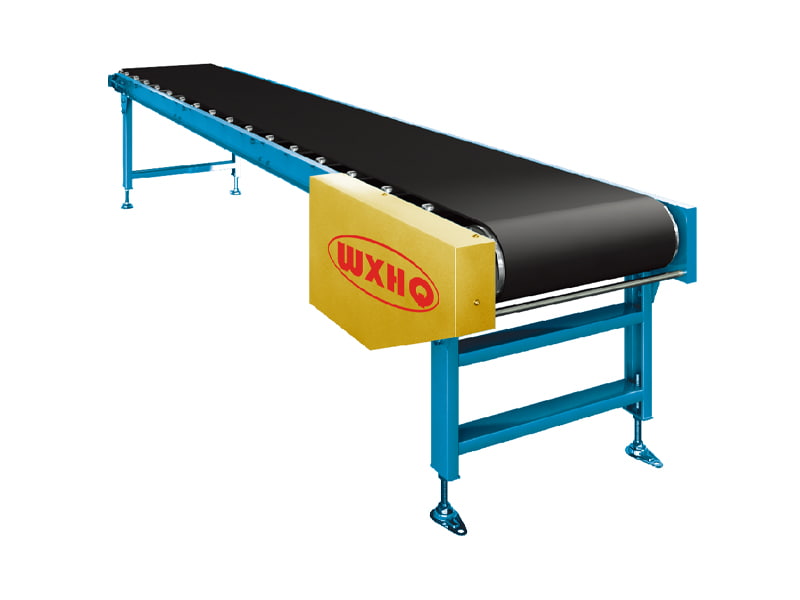 Standard type belt conveyor SuppliersWuxi Huiqian Logistics Machinery Manufacturing Co., Ltd. is a professional logistics equipment manufacturer founded on the foundation of advanced Japanese technology ....View Product →
Inclined runs
On a smooth belt the incline is limited by friction between belt and product base. Past that limit items slide or roll back, and a cleated or flighted belt becomes the practical answer rather than more tension.
Turning runs
Turns of 45, 90 or 180 degrees redirect flow without a second conveyor. A knife-edge or tapered pulley at the turn keeps the belt tracking, and the inner radius must be wide enough for the product to swing through without catching on the frame.
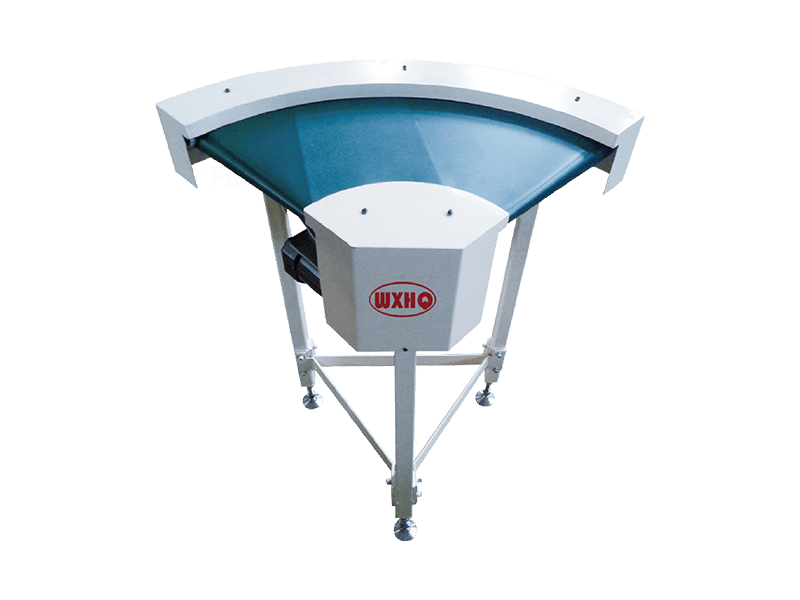 Turning Belt Conveyors SuppliersIn modern logistics and manufacturing environments, the safe and efficient transfer of materials is critical. One common challenge is ensuring that products remain sta...View Product →
Frames, carrying rollers and drum motors built by one manufacturer keep the tolerance chain short, because the pulley crown and the belt specification are set by the same engineering team. The production and certification background behind these lines is worth checking before a first order.
Specification Checklist Before You Order
Six numbers constrain most flat belt conveyor designs: belt width, load per item, throughput per minute, incline angle, available length and the operating environment.
| Specification item | Typical range | Cost of getting it wrong |
| Belt width | 200 mm to 1200 mm | Too narrow means rework; too wide wastes belt and frame cost |
| Load per item | Up to 50 kg on a smooth belt | Sized on average load, the line fails on the heaviest item |
| Speed | 5 m/min to 60 m/min | Too fast causes transfer instability and faster belt wear |
| Incline | Up to 15 to 20 degrees smooth | Product slides back and the belt loses grip on the pulley |
| Environment | Washdown, oil mist, heat, dust | Wrong belt and bearings fail within months, not years |
Common Problems and How to Fix Them
Most flat belt faults trace back to tension, tracking or the transfer point, usually in that order of frequency.
- Belt runs to one side. Check frame level and pulley crown first, then adjust the take-up evenly on both sides in 1 mm to 2 mm steps.
- Belt slips under load. Clean the pulleys, inspect the lagging and raise tension only within the available take-up travel.
- Splice fails. A misaligned step or finger splice strikes the pulley once per revolution. A good splice is square and skived to belt thickness.
- Product tips at the transfer. Close the gap, reduce the drop, or add a short nose bar so the item keeps support until the next belt takes it.
- Belt edge frays or curls. Usually over-tensioning or the belt rubbing the frame; check the clearance between belt edge and frame side.
A fuller maintenance schedule, including cleaning intervals and bearing checks, is set out in this belt conveyor maintenance guide.
Frequently Asked Questions
What is the difference between a flat belt conveyor and a roller conveyor?
A flat belt conveyor carries items on a continuous belt surface, which suits small parts, bags and unstable loads. A roller conveyor carries items on a series of rollers and needs a firm, flat base such as a pallet or a rigid tote. Flat belts are gentler and quieter; roller conveyors handle heavier unit loads and accumulate more easily.
Can a flat belt conveyor run on an incline?
Yes, up to roughly 15 to 20 degrees with a smooth belt, depending on friction between the belt and the product base. Above that angle a cleated or flighted belt is needed, because items slide or roll back even with correct tension.
What belt width do I need?
Belt width should be at least 50 mm to 100 mm wider than the widest product, and the product centre of gravity should stay inside the belt edges through every transfer. Standard widths run from 200 mm to 1200 mm; wider belts need more frame support and a larger pulley to stay on track.
How often should a flat belt conveyor be re-tensioned?
With 30 mm to 60 mm of screw take-up, most belts need adjustment only during the first weeks while the belt settles. After that, check tension every few months; repeated re-tensioning usually points to belt stretch, a failing splice or an overloaded line.