

 ENG
ENG 中文简体
中文简体 русский
 Français
 Español
 日本語
日本語 عربى
عربىContent
Belt conveyor reliability comes down to three variables: belt tension, pulley alignment, and whether the belt specification actually matches the material running on it. Everything else is usually a symptom.
A belt conveyor that moves 1,200 cartons an hour through a distribution center and one that hauls 400 tons of aggregate per hour in a quarry share the same working principle, but almost nothing about their design is interchangeable. Belt width, carcass plies, cover compound, drive size and take-up type are all chosen around the load, the environment and the layout.
When buyers compare quotations for a belt conveyor, the prices often land in a narrow band while everything else differs: belt brand and ply count, drive arrangement, frame gauge, tracking devices, and who owns the control integration.
A stopped belt conveyor rarely stops alone. One mistracked belt at a transfer point can idle the packaging line, the palletizer and the outbound dock within a few minutes.
What Is a Belt Conveyor?
A belt conveyor is a continuous-transport machine that carries material on an endless belt loop, supported by idlers or a slider bed and driven by a head pulley or a drum motor.
It becomes the default choice when the load is loose, irregular, wet, hot, or too small to sit stably on rollers. The same architecture scales from a 300 mm wide packaging conveyor feeding a case sealer to a 1,600 mm wide bulk line moving crushed stone.
- Belt: carcass of fabric plies or steel cord, plus top and bottom cover compound
- Drive unit: head pulley with gearbox and motor, or a drum motor built into the pulley
- Tail pulley with a take-up device that maintains working tension
- Carrying idlers or a slider bed, and return rollers under the belt
- Frame, support legs, loading chute, skirt rubber and belt cleaner
- Tracking devices, guards, pull cords and speed sensors
Definition: a belt conveyor is a friction-driven continuous handling machine. The belt is both the load-carrying surface and the traction element, which is why tension and cover condition affect capacity and belt life at the same time.
How a Belt Conveyor Moves Material
A belt conveyor works by friction drive. Belt tension presses the belt against the rotating drive pulley, friction converts that rotation into linear belt movement, and the belt carries the load along the frame.
This is why a slipping belt is rarely a motor problem. If tension drops, the pulley simply cannot transmit the torque it already has. Take-up devices, whether screw, gravity or hydraulic, exist to hold that tension as the belt stretches in service. Throughput follows an equally simple relationship: capacity equals load cross-section area multiplied by belt speed, bulk density and a surcharge factor. Raising belt speed is usually cheaper than widening the belt, up to the point where material starts to bounce or generate dust.
Drive arrangement is the other major fork in the road. A conventional head pulley with an external gearbox and motor is easy to service with standard parts. A drum motor houses the gearbox inside the pulley, removing the external drive package and sealing the moving parts away from dust and washdown water.
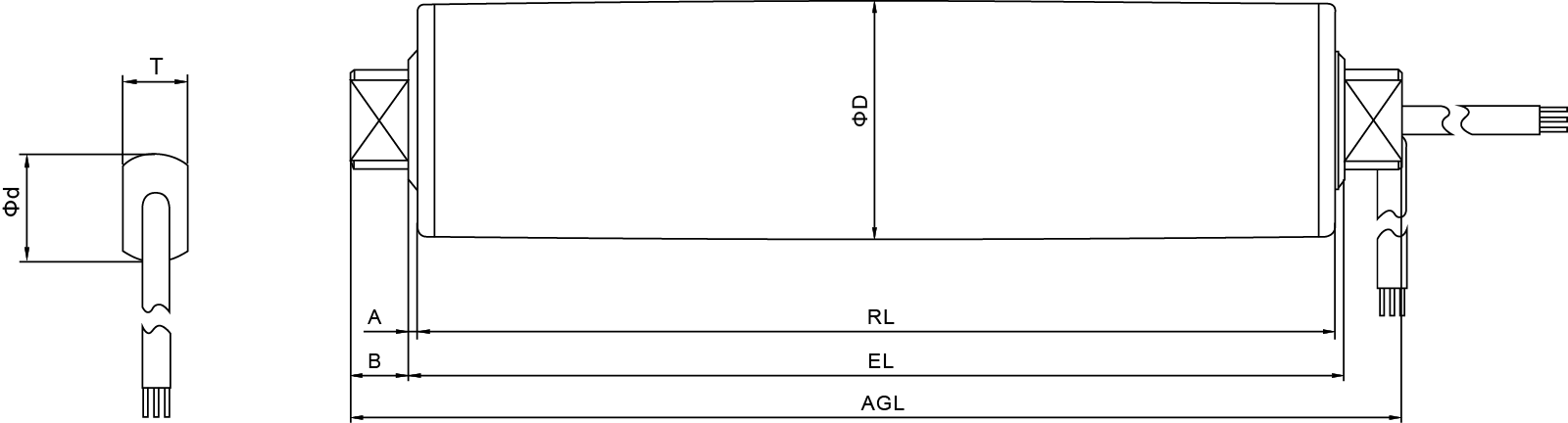 Oil-Cooled Drum Motors for Belt Conveyor DrivesFor belt conveyors, these oil-cooled drum motors house internal components in lubricating oil and use a drum shape to help prevent belt misalignment.View Product →
Before adding motor power, check take-up travel, pulley lagging and belt tracking. Most underpowered belt conveyors are simply losing traction they already paid for.
Belt Conveyor Types and Configurations
Belt conveyor types are defined by four choices: belt construction, belt surface profile, frame path, and duty class. Width, speed and drive size follow from those.
The standard flat belt conveyor remains the baseline of industrial material handling. With a PVC or PU belt, a head pulley drive and a correctly sized take-up, it covers most carton, parcel, part and assembly-feeding duties without any special features.
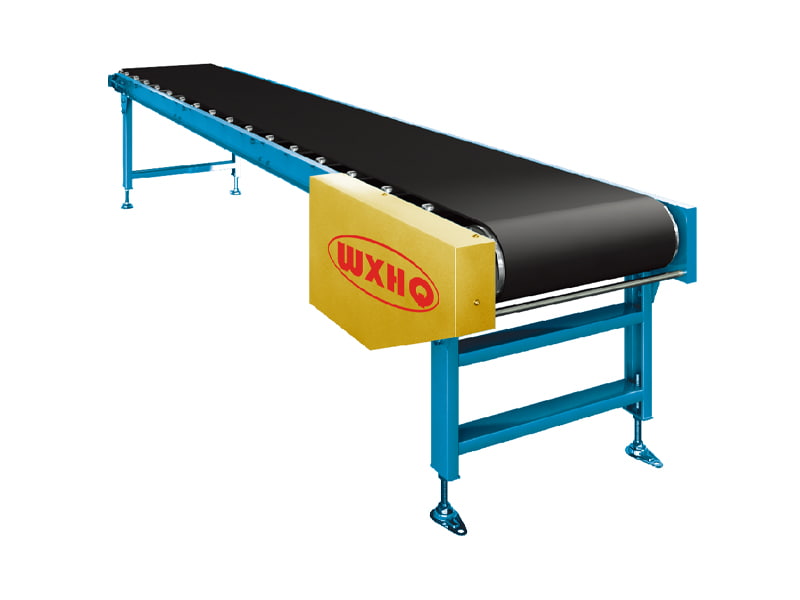 Standard Flat Belt Conveyors and Lightweight Belt SeriesStandard flat belt conveyors with PVC or PU belts cover common carton, parcel, part and assembly-feeding duties, plus lightweight small-belt models under 100 kg.View Product →
| Type | Belt and drive | Typical duty | Watch out for |
| Standard flat belt conveyor | PVC or PU, 2 to 3 ply, head pulley drive | Cartons, parcels, light parts | Belt tracking on long spans |
| Troughed bulk conveyor | Rubber cover, 3-roll idlers, heavy duty drive | Aggregate, grain, cement | Impact and spillage at the loading point |
| Incline or decline conveyor | Rough-top or cleated belt | Level changes inside a line | Material roll-back above 20 degrees |
| Turning belt conveyor | Curved frame with tapered end rollers | Corner transfers in L-shaped layouts | Edge stress on the outside radius |
| Stamping line belt conveyor | Oil and heat resistant cover | Stamped parts and press scrap | Oil swelling and scrap puncture |
| Modular belt conveyor | Plastic modules on sprockets | Food, bottles, washed items | Cleaning around hinge points |
Special designs solve specific problems, not general ones. A turning section, a cleated belt or a modular belt earns its cost only when the layout, the material or the cleaning regime genuinely demands it.
How to Choose the Right Belt Conveyor
Specifying a belt conveyor comes down to five inputs: load characteristics, required throughput, layout geometry, operating environment, and the control system the belt must talk to.
- Define the load. Unit weight, footprint, temperature, abrasiveness, oil content, and how the item is actually placed on the belt.
- Fix throughput and speed. Peak rate, not average rate, decides belt width and installed drive power.
- Lock the layout. Total length, incline, number of transfer points, and whether a turning section removes a handoff.
- Choose the belt construction. Ply count, cover compound and cover thickness; food, oil, heat and abrasion each point to a different specification.
- Size the drive and tension. Motor power, pulley lagging, take-up type and travel, then confirm starters, sensors, e-stops and line integration.
Belt conveyor
- Handles loose, irregular, wet or hot material
- Inclines up to about 20 degrees with the right surface
- One drive point and one traction element
- Needs tracking, tensioning and belt splicing
Roller conveyor
- Handles rigid items with a firm, flat base
- Runs level or slightly declined, with zone accumulation
- No belt to track, tension or splice
- Item stability and roller pitch decide performance
Rule of thumb: if the product cannot sit flat and stay there, specify a belt conveyor. If it can, and you need zone-based accumulation, rollers usually cost less to own.
Applications and Layout Decisions
Belt conveyors carry three broad categories of load: bulk materials, manufactured and stamped parts, and packaged goods in logistics operations.
Bulk and heavy industry
Aggregate, grain, cement and fertilizer move on troughed belts supported by idlers, with drives sized for full-load starting.
Manufacturing and stamping
Stamped parts, press scrap and assembly components need oil-resistant or heat-resistant covers, plus part counting and metal detection.
Food and logistics
Washed vegetables, packaged food and parcels call for food-grade belting, washdown-friendly frames and easy cleaning access.
Turning belt conveyors replace a right-angle transfer with a curved frame and tapered end rollers, so the belt itself carries the product around the corner. That removes two of the most common jam points in a line, the transfer gap and the handoff between two machines, provided the tapered rollers balance inside and outside belt speed.
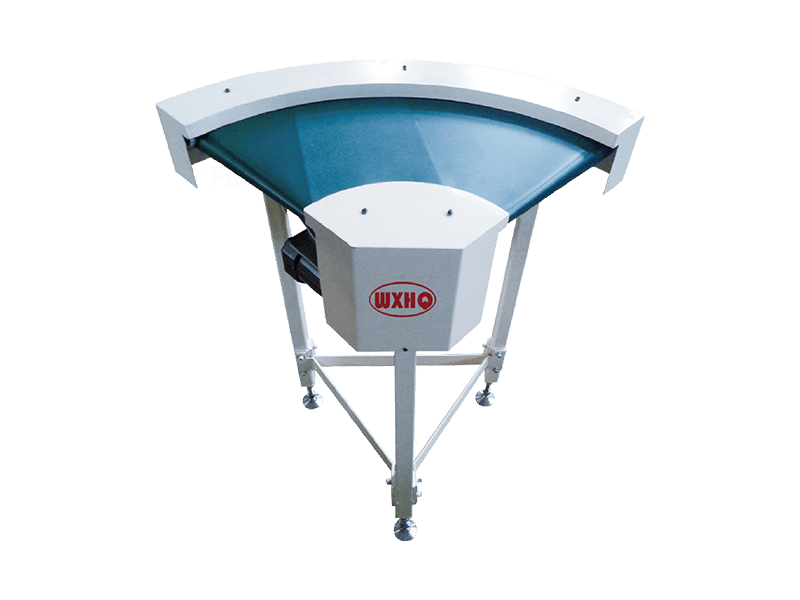 Turning Belt Conveyors for 90 and 180 Degree TransfersTurning belt conveyors use curved frames and tapered rollers to carry products around 90- or 180-degree corners, reducing transfer gaps and handoff jam points.View Product →
Maintenance and Troubleshooting
Most belt conveyor downtime traces back to four failures: mistracking, belt slip, splice failure, and seized idlers or pulleys.
- Tracking: verify pulley squareness and take-up symmetry after every belt change, not only when the belt starts to wander.
- Tension: measure take-up travel on a monthly schedule, because belt tension governs how much motor power reaches the belt.
- Splices: inspect mechanically fastened splices at every shutdown; they normally fail long before the belt carcass does.
- Idlers and pulleys: a seized roller or worn lagging is both a hidden power loss and a heat source.
- Cleaning: material buildup on return rolls is the most common root cause of edge damage and early belt replacement.
Tension is the thread running through all of it. Too little causes slip and belt wander, too much shortens bearing and splice life. A practical note on how belt tension changes conveyor efficiency is worth reading before anyone reaches for the take-up bolts.
If a belt tracks to one side only when it is loaded, the problem is usually loading position or frame level, not the belt itself.
Frequently Asked Questions
What is the difference between a belt conveyor and a roller conveyor?
A belt conveyor carries the load on a continuous flexible surface and can handle bulk, irregular, hot or wet material on an incline. A roller conveyor carries rigid, flat-bottomed items on rotating rollers, runs level or slightly declined, and is easier to divide into accumulation zones.
What causes a belt conveyor to mistrack?
Four causes cover most cases: an off-square head or tail pulley, uneven take-up so tension differs side to side, off-centre loading, and material buildup on rollers and pulleys. Correct the cause rather than adjusting the belt to hide it.
How long can a single belt conveyor run be?
For flat process belt conveyors, 50 to 150 m on one drive pulley is a common working range, with longer runs using multiple drive pulleys or booster drives. Heavy troughed bulk conveyors can run far further when the belt rating and drive arrangement allow it.
Can belt conveyors handle high temperature or oily parts?
Yes, with the right cover compound. Heat, oil, abrasion and food contact each call for a different belt specification, and the frame, bearings and pulley lagging need to match the same environment.
Belt conveyor specification is a short list of decisions with long consequences. Matching belt construction, drive arrangement and take-up to the real load is what separates a line that runs for a decade from one that is re-spliced every quarter.
Wuxi Huiqian Logistics Machinery Manufacturing builds belt conveyors, roller conveyors, drum motors and the components behind them, with background on the factory and certifications available in the company profile. If you are specifying a line, send the load data first: unit weight, peak rate, temperature and layout define everything that follows.